Tuesday, October 26, 2010

Darlinghurst: Street Art: Concrete Penis Gun

This concrete penis gun sculpture was well-camouflaged on the sandstone walls of ye old Darlinghurst Gaol. The gun is just one of many concrete works - including concrete televisions, concrete remote controls and concrete teddy-bears - by artist Will Coles, which he carefully places among the landscape in Darlinghurst, neighbouring Surry Hills and Newtown, in Sydney's inner west.
If you can manage to prise the cock-gun off the wall, you could flog it on eBay or just give it pride of place in your pool-room. But I would never condone such theft.
The work is called, Guns for Wannabe Gangsters (Suck My Cock), and you can read Coles's take on it at his Flickr site here.
I like Coles's work, which seems to be a timely comment on society's endless consumerism: at the moment around Darlinghurst there are loads of old televisions sitting on the footpaths and around garbage bins, as viewers are forced to upgrade to new digital sets before the analog signal is switched off next year. It seems like such a waste and it's a shame they can not be recycled.

Monday, October 25, 2010

Darlinghurst: Street Art: Oxford Art Prize

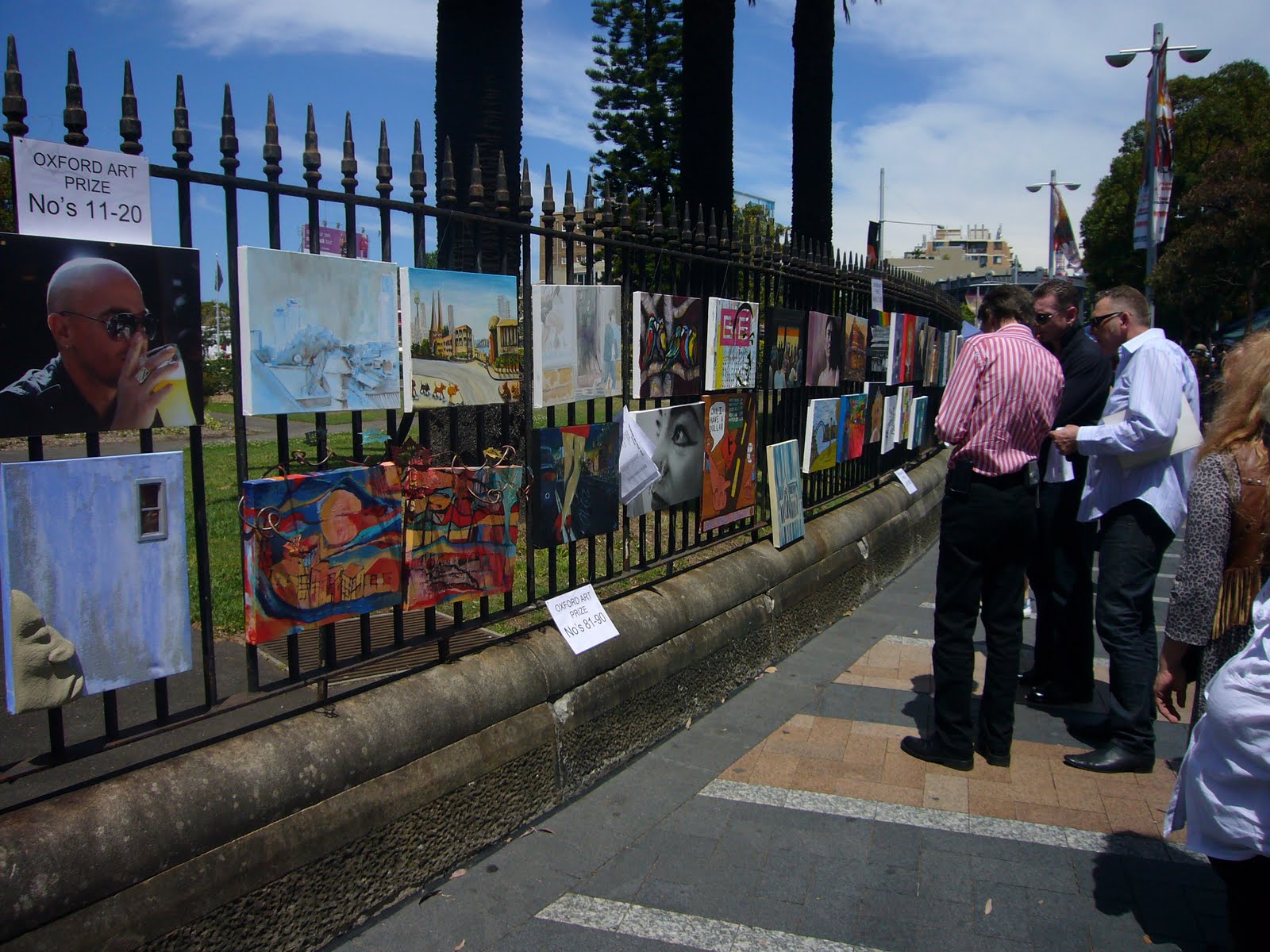
Saturday was sunny and promising so I set out with my friend, Crystal Kaye, to explore the neighbourhood and it wasn't long before we made a discovery: dozens of colourful canvases strung along the fence poles of the Darlinghurst Court House.
The six-hour Oxford Art Prize exhibition, made up of 100-plus works, was part of the Oxford Arts Festival, which runs until October 30.
The inaugural 12-day festival was designed to promote the arts, artists, restaurants and retailers of Oxford Street and Darlinghurst, which is surprising seeing as I had never heard of it.
The festival's online home is this blog that has posted just two stories since April, and has only one follower - even less than My Darling Darlinghurst.
I love a festival, especially if it's local, but it's a shame when they fail on the publicity front and don't attract the punters.
There were even mimes and other performers, including this wonderful band, to entertain the potential crowd:

The outdoor exhibition also coincided with the Sydney Sustainable Markets, which are held every Saturday at Taylor Square, so apart from art, there was lots to look at:

Compact Vegie Garden On Show

Himalayan Orchids For Sale

I'll be writing a more comprehensive account of the markets on a later visit, because on this day Crystal and I were having a fine time judging the art. The Oxford Art Prize also allows the public to vote for their favourite work. We didn't plan on it, but Crystal and I ended up voting for the same painting:

Inside and Outside in Darlo, by David Wilson

Crystal thought Wilson was the most talented artist on show. I liked his absurd characterisations and the painting's sense of debauchery. Wilson's style also reminds me of the work of veteran newspaper cartoonist and illustrator Bruce Petty.
Meanwhile, the three real judges - Dean of COFA Ian Howard, the National Art School's Stephen Little and art dealer David Rex-Livingston - were busy scratching their chins as they tried to pick a winner:

Crystal and I asked the man manning the desk when they were going to announce the winner, because we had other adventures to carry-out. But he was a bit vague and only said it would be announced between now and 4pm. Which was about two hours away.
So we wandered off and came back an hour later, asked around and learnt that the winner of the People's Prize was this striking photograph on canvas:

Augenblick, by Mandy Schone

We never learnt who won the Oxford Art Prize and the festival blog so far hasn't announced the winner either.

Sunday, October 24, 2010

Darlinghurst: Public Transport: The 311 Bus


A small part of my week is taken up by scenes such as this:


And this:


And this:


It may not look like the greatest place to be, but while I'm seated there, looking at the backs of people's heads, I couldn't be happier, because I have just managed to catch the 311 Bus. And that's no easy feat.
The 311 Bus - or the 311 Mystery Bus as it is known to dozens of Darlinghurst's residents who spend a great deal of time waiting at the bus stop for the ride that never arrives - is a vehicle that inspires mixed emotions.
When it fails to show up, or arrives early so that I miss it, I curse the damn thing and then fork out $10 for the cab to work.
But when it arrives on time - and the driver actually sees me and pulls over - I just love that bus.
Then there are the other times when I'm in no need of public transport and I see the 311 waiting impatiently at the lights, rearing to go:

Or just storming past in a blaze of blue paint and petrol fumes:

It is during these moments that I feel compelled to turn to the person nearest to me and say, ''Look! There's the 311!''
Such is its phantom-like allure.

The 311 route could not be more efficient. It begins its journey down at the loop in Elizabeth Bay, chugs up Greenknowe Avenue, cruises along Macleay Street, hoons along Victoria Street and tears down Oxford and Elizabeth streets along the edge of the CBD to Central Station.
From my bus stop on Victoria Street, it takes me only 10 minutes to arrive at work on the 311.
There's also a 311 Doppelganger bus that begins its route at the Elizabeth Bay loop and ends at Circular Quay, near Sydney Harbour, but that doesn't service Darlinghurst residents.
Darlinghurst instead has the 389 Bus from Bondi Junction in Sydney's eastern suburbs, which happens to pass along Burton Street and down through Little Italy (in the Darlinghurst Valley or Flats) on its way to the Quay. It is a bus that isn't purely devoted to the suburb and I only use it when I need to go to David Jones department store, because it stops right outside the door on Elizabeth Street.
There's also an army of buses that plough along Oxford Street on their way to and from other places, but I am not interested in those itinerants.
To catch the 311 it is useful to have one of these:

You can buy the TravelTen ticket at most convenience stores in the area and for $16 you can take ten rides on the 311 that would normally cost $20 if you were paying by cash.
The alternative commute to Central Station from Darlinghurst is by train, which departs from nearby Kings Cross, but that costs $3.20 for a one-way trip.
There is also this bus:

But it costs $30, cruises around the city endlessly and is designed for tourists.

The other thing I love about catching the 311 is the curious people, overheard conversations and occasionally interesting graffiti that can be found inside its hallowed interior.
I have seen some strange commuters, usually nervous-looking middle-aged men, who hop on the bus at Taylor Square and then alight at Whitlam Square, a journey of about 500m that would be more efficiently traversed on foot. These people are not elderly, generally look healthy and I often wonder about their motivation. Perhaps, like me, they just simply love being on the 311.
I also spent one trip listening in to a conversation between two women in which I received a detailed account of one's mental health history and whether or not she was presently going through a manic period. Judging by the tone and volume of her voice, I gave her a positive diagnosis.
Then yesterday, while luxuriating in the sun on the 311, I spotted this collectable sticker on the back of a seat:


Here's a close-up:

The caption reads: Disappointment, Number 4 in a Series.
I wonder if the man in the photograph is standing at a bus stop somewhere in Darlinghurst, still waiting for the 311.

Saturday, October 23, 2010

Darlinghurst: Heritage Items: Hilton

Hilton
- Register of the National Estate, City of Sydney Council Heritage List
Australia's first Hilton is located at 278 Liverpool Street, and in a nice bit of synchronicity, the three-storey mansion, which was built in 1854 by a man who dabbled in painting, is today the premises for art dealer Robin Gibson.
Scotsman John Rae came to Australia in 1839 and initially worked as an accountant for the North British and Australasian Loan and Investment Company.
But Mr Rae was an ambitious and brilliant man and by 1843 he was appointed the first full-time clerk's position with the now City of Sydney Council, pocketing a salary of 300-pounds.
During his time with the council Mr Rae made important contributions to the areas of public health administration and the Sydney Corporation Act.
In 1857, three years after building Hilton, as a home for his wife and six children, Mr Rae took a 250-pounds pay-rise to become secretary to the Railway Commissioners.
He must have excelled in his job because four years later he was appointed under-secretary for public works and commissioner for railways, which came with an 800-pound salary - not bad for those wild colonial days.
In train-spotting circles Mr Rae is best known for creating the first profit and loss accounts of any railway system in the world. These accounts, which were compiled within the railways' annual reports, earned Mr Rae international recognition: when he travelled to Europe in 1879, the Poms presented him with a free railways pass, while the Germans provided him with a special train and staff.
Mr Rae wasn't just a numbers man, he was also a deft hand with a camera and a paintbrush, creating many works viewed from the windows of his mansion, Hilton.
A notable 1877 watercolour by Mr Rae captures cows grazing on the corner of Liverpool and Forbes streets, and was probably taken about the same time as this photo.
Another watercolour shows William Street as a goat track leading up to St Mary's Cathedral, which was originally built in 1821 and destroyed by fire 44 years later. (The cathedral was rebuilt in 1882 by John Young, who also designed Sir Henry Parkes' Annandale mansion, The Abbey. It was rumoured Mr Young stole gargoyles from the church to use on Parkes's building. St Mary's spires were added in 2000.)
There is a fascinating trove of Rae's photographs and watercolours archived online by the State Library of NSW, which include scenes of Newcastle, Wollongong as well as Sydney's first streets and buildings. The archives also contain an excellent photograph of the Victorian Georgian-style, Hilton, in its heyday that you can look at here.
The industrious Mr Rae was also a keen writer and his last published work, in 1898, was a biography of engineer John Whitton, tantalisingly titled, Thirty-Five Years on the NSW Railways.
Two years later, at the age of 87, Mr Rae died and was buried at Waverley Cemetery, in Sydney's eastern suburbs.
I don't know what became of Hilton, or who lived there over the next eight decades, but in 1981 it sold for $240,000 and became home to the Robin Gibson Gallery.

Thursday, October 21, 2010

Darlinghurst: Street Art: Cupco

Loitering around the Bourke Street badlands in Woolloomooloo and Darlinghurst today, these colourful characters caught my eye. They look like some bent, Japanese comic book heroes and monsters, and there were posters of them all the way along the street. I like to think of the pair above as Three-Eyed Web Man and Twin-Pocket Geek.

The chap above would have to be The Crab Monster.

These two look like Redneck One and Redneck Two.

You may have noticed the word CUPCO in large capital letters beneath each character and you may have thought this was just another plastic-cup promotion stunt.
But no, a genuine artist is behind these posters and the only thing he is selling is felt dolls, which look like his mad characters, and have detachable heads. He's a bloody genius. I have a secret fondness for dolls and now I want one of Luke Temby's hand-made friends. He even offers a custom-made doll service where you can have a felt character made in your likeness.
Temby, who is in his late 30s, was inspired to make his wacky dolls during a five-year stint in Japan. He arrived back in Australia, with his own living doll, wife Mayumi, and set about building a doll empire of more than 100 pieces.
Temby has made dolls of Osama Bin Laden, female suicide bombers, Jesus, Satan, Scientology founder L. Ron Hubbard, Joan of Arc, the multi-armed Hindu goddess Kali and former standover man turned author Mark Chopper Read.
He has also held a couple of solo shows at the Damien Minton Gallery in Redfern, in inner-Sydney, where in 2007 the doll of Hubbard - being shot out of a felt volcano - was listed for sale at $850 and dolls of the Pope and the Queen sold for $950 each. Joan of Arc being burned at the stake - while listening to The Smiths on her walkman - sold for $850.
I rather fancy the Suicide Angels, which are limited to an edition of ten, and are relatively inexpensive at $350.

Temby lives in Summer Hill, in Sydney's inner-west, so I'm guessing it was one of his minions - or a fan who requested free stickers through his website - that pasted these colourful posters up around Darlinghurst.

Tuesday, October 19, 2010

Darlinghurst: Food: Forbes and Burton

After a week of cold weather and a few days of gales, Spring finally stuck its head out from under a rug of clouds to make Sunday a fabulous day to head outdoors again. I spent the morning running errands and by 2pm I still hadn't eaten a scrap, so when Ruby Molteno called and suggested a late lunch, I swung by, scooped her up and we landed promptly at the doorway of Forbes and Burton cafe.
On such a lovely day we were surprised at first to discover an available outdoor table, so we donned hats and sat in the sun . . . until we became so sickeningly hot from its rays, and realised why most diners were sitting inside.
We placed our order and moved inside too:

Forbes and Burton is located in an 1850s building that stretches all the way from 238-252 Forbes Street, and is listed on the Register of the National Estate. I'll be doing a post soon about the history of the building, known as the Belgrave Terrace.
But I still can't talk about its 21st Century life without mentioning the building's historical sandstone walls with their chip marks from the workers' picks. The building is right across the road from the National Art School and former Darlinghurst Gaol, which is mainly built from sandstone that was dug out from the local area by convict workers.
The gaol was constructed between 1821 to 1841 and I wonder if the sandstone used on the Belgrave Terrace was hacked out by its convict neighbours or was left-overs.
The interior design of Forbes and Burton makes the most of the building's heritage aspects, but also includes nice modern embellishments, such as this crimson-pink, reflective panel:

The building was home to the very trendy Dov cafe until 2006 when David Pegrum, a former head chef at the internationally acclaimed Sydney restaurant Tetsuyas, took over the kitchen.
I ordered the special of the day, which the waiter incorrectly recited to me, and which turned out to be Braised Chicory and Salmon Fillet en Papillote with Asparagus ($22). The waiter wasn't far off the mark though (he thought the chicory was witlof) and he was right when he said it was a good-looking dish:

It tasted great too and there was some wilted greens, drenched in deliciously fattening butter, hidden beneath the fish. Ms Molteno, the all-day breakfast queen, ordered poached eggs with whole-grain toast, bacon and tomato:

I asked Ruby why on earth she always orders bacon and eggs when she could easily cook them at home. She said it's because she doesn't like to have bacon in the fridge as she wants to keep fatty temptations right out of sight. I suspect the real reason is because she doesn't much like cooking. Ruby then went on a discourse about how such a seemingly simple dish can be cooked so many ways and how each cafe's bacon and eggs tasted completely different.
Ruby said she didn't truly realise this until she went to London many years ago and discovered to her horror that some cafes didn't know how to cook bacon and eggs. As for the Forbes and Burton version, Ruby was full of admiration: the eggs were plump and free range, the tomatoes were Roma and the bacon wasn't too salty.
Then because I hadn't eaten all day and because I had to work in the evening and life is too short to say no to anything, I ordered the Chocolate Brownie with Raspberry Coulis and Yoghurt:

We weren't quite sure about the yoghurt blob - surely it should have been double cream - but the sourish yoghurt and raspberry were a good foil for the sweet chocolate.
*
Forbes and Burton
252 Forbes Street
Darlinghurst NSW 2010
02 9356 8788

Monday, October 18, 2010

Darlinghurst: Detritus: Electrical Substation Flyer


This flyer was posted in the window of the newly relocated Bill Warner Chemist on the corner of Victoria and Surrey streets.
Energy Australia are hoping to install new kiosk substations in the area to cater to the increased demand for power, and obviously some people aren't happy about it.
The kiosk mentioned in the flyer above is set to be installed on Surrey Street, just outside Dr Warner's shop door.
Energy Australia says it will result in the loss of one car space, but that a nearby Plane tree will be unaffected. Save the car space, saw down the tree, I say.
The kiosk is rather big (about 2.7m long, 1.5m wide and 1.6m high) and not all that pretty but I don't really understand the fuss Dr Warner is making - especially when he keeps his shop lights on all night.
It also appears that the Surrey Street location is an alternative to Energy Australia's original and foolish plan to place the kiosk within the grounds of St John's Church across the road, which was opposed by the Darlinghurst Residents Action Group in August.