Showing posts with label Past and Present. Show all posts

Sunday, October 21, 2012

Darlinghurst Blog: Past and Present: Higgs Corner

So the Frenchman never sent me any more pix as promised (see previous post), and I don't write or speak his language so I can't really blame him. 
But never mind, because this major crossroad of Darlinghurst Road and Victoria Street - which his Papa had photographed in the 1960s - had already been on my radar, specifically the corner of William Street and Darlinghurst Road (pictured above in 1936).


Back in the early 20th century it was known as Higgs Corner (pictured above in 1916). It was called this because the building was once home to A.A. Higgs, a bootmaker who specialised in surgical shoes and "repairs by craftsmen skilled in the art". 
I guess Higgs was the early 1900s version of the Surry Hills Perkal Bros who were profiled in yesterday's Good Weekend in The Sydney Morning Herald.


In September 1916 Flora Helena Mann and Daniel Spillane, executors for the will of Esmay Farrell sued the Municipal Council of Sydney for compensation for the land at Higgs Corner.
The property had been resumed by the council for the widening of William Street at a cost of 8,800 Pounds. But Mann and Spillane wanted 18,000 Pounds. 
(There's not much talk about Esmay Farrell in the archives, except for her estate, because she apparently owned the York Hotel in Central Sydney. Was she a descendant of the Farrell of Farrell Street? A relative of Bumper Farrell? I'm afraid I can't shed any light with my research budget.)
In case you are interested, the photograph above from the City of Sydney Archives, was taken in March 1918, probably just before the building was demolished.


Here's another view (above) from the archives of 1918, from the perspective of Darlinghurst Fire Station. As you can see Mr Higgs is having a sale, no doubt because his building is about to be demolished.
As an aside, Ms Farrell's estate also had an address known as 1A Craigend Street, which was declared, in April 1939, a "common gaming house". Legal action was taken against the tenant, Frank Benjamin.


The picture at the top of this post shows what the corner looked like in the 1930s, after Higgs Corner was demolished, but William Street was widened or realigned again in the 1970s for the Kings Cross Tunnel, so the building pictured above (from City Archives) now marked the corner. 


In the 1980s the building was home to Michelangelo's (above, from City Archives), an Italian cafe with gelato, pasta and espresso coffee. 
The cafe stayed for many years and was still there in the late 1990s as far as I can recall. 
Do you remember the old news stands, like the one above? 
I vividly remember the one at Taylor Square and frequented it to buy American Vogue and The Face magazine. 


In recent times Higgs Corner has been home to a series of not so successful bars, such as Firebar, shown above. 


At the moment Higgs Corner is home to a bar awkwardly named Awkward. 
It seems to be going OK, despite the fact they have strange displays in which they place a live model dressed in colourful clothing in the Darlinghurst Road window on random evenings. 
Not sure what that's about, but the location looks like a good place to have a coffee on a sunny day.


SOURCES:

Monday, October 8, 2012

Darlinghurst Blog: Past and Present: French Photographie


I was contacted last week by a Frenchman Marc Coetmellec who emailed me three photographs his father had taken of Darlinghurst in the 1960s. They have never been published before, so I am very pleased that Marc sent them to me to include on my petite blogette. The photographie is fantastique.
This first one, looking down William Street, shows the original Bar Coluzzi on the left. 
There is a similar photograph in the City of Sydney Archives, which shows the cafe proprietor standing at its doorstep. 


The scene today is quite different as the road was realigned in the 1970s for the Kings Cross Tunnel, Sydney's first road tunnel according to this website.


Marc's father, Jean-Yves Coetmellec, visited Australia frequently in the 1960s as a merchant seaman on board the Tahitien (do click on the link to see a photograph of this lovely ship). 
Jean-Yves was a mecanicien, or mechanic, with the French maritime company Messageries Maritimes (again, click on the link to see the beautiful old shipping posters).


The Tahitien would have docked at Woolloomooloo so Jean-Yves would have been well placed to explore the local area, including Darlinghurst and Kings Cross. I wonder what the Frenchman thought of Sydney in the 1960s. And would he be interested to see what the area in these photographs looks like today:


Marc said he had many more photographs of Sydney taken by his father and he promises to email them to me. I can't wait to see them and will publish them here as soon as I can.

Friday, February 10, 2012

Darlinghurst Blog: Past and Present: Corner of William Street and Kirketon Road

The corner of Kirketon Road and William Street is a rather bland, nondescript junction these days, not conducive to lingering. 
But back in the 1950s it was a bustling corner and home to the original Bar Coluzzi:


This photograph, from the City of Sydney Archives, was taken in 1957 and shows Luigi Coluzzi standing in front of his eponymous cafe. Inside the darkened doorway sits Eleni Coluzzi. 
I still find it hard to believe it is the same location in the contemporary photograph, but according to the archives, the photographer is standing on the corner Kirketon Road, looking down to Rosebank Street. 
I again pulled out the old City Building Surveyor's maps to see what the corner once looked like from a geographical perspective, but the building must have been demolished prior to the building survey, as there is no trace of this row of shops, which also includes a laundrette, a bird shop and chemist. 


*

And here's a glimpse of Bar Coluzzi as it is today:


*
Bar Coluzzi
322 Victoria Street
Darlinghurst NSW 2010
02 9380 5420

Tuesday, January 24, 2012

Darlinghurst Blog: Villas of Darlinghurst: Goderich Lodge

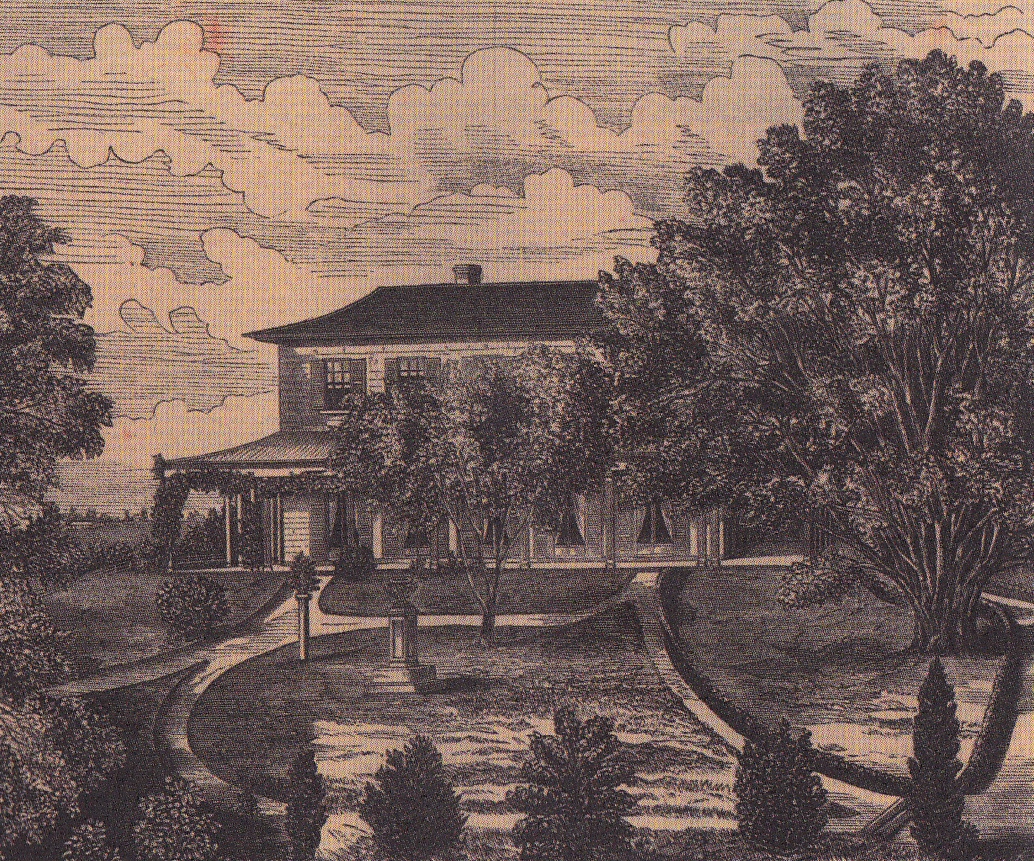
Goodrich (sic), The Residence of Captain Smith, artist unknown, 1875 (detail).
Goderich Lodge: allotment of over four-acres granted to Thomas Maquoid in 1831.

This Darlinghurst mansion-house, or villa, was designed by John Verge for the High Sheriff of NSW, Thomas Macquoid, and was situated near what is now the corner of Bayswater Road and Penny Lane. 
Born in Ireland, Macquoid came to Australia in 1829, following a period in Java, where he produced coffee crops for the East India Company, as well as a tenure as Sheriff of India.
The 1832 mansion house was named Goderich Lodge, after Lord Goderich (Frederick John Robinson), the then Secretary of State for the colonies, who was also the British Prime Minister for a brief period. 
Macquoid arrived in Australia full of optimism for his new role in a new colony, but very soon had slunk into depression.
His first major issue was with his new job, which he believed did not have the appropriate status for such an important position. His office was also understaffed and overwhelmed with work. Litigation and bankruptcy proceedings were rife and there were over 700 summonses to be served.
To worsen things, Macquoid was also suffering financially after investing in a large farming property in the Tuggeranong Valley, near Canberra, which he named Waniassa. The country had been hit by drought, while the colony was also in financial collapse. 
Unable to cope, Macquoid committed suicide in October, 1841, leaving his son Thomas Hyam to deal with his mounting debts.
(Incidentally, Thomas Hyam was one of 121 people who died aboard the wreck of the clipper, Dunbar, which crashed into rocks at South Head, at the base of suicide-spot, The Gap, in 1857; his body was never recovered. The Dunbar's anchor was retrieved and is mounted at The Gap as a memorial.)


Goderich Lodge was sold at auction two months after Macquoid's death and in the years that followed was rented by the First Bishop of Australia, Dr William Grant Broughton, whose wife died at the house in 1849. 
The next tenant was Surveyor General Samuel Augustus Perry, and then in the 1850s, Goderich Lodge was purchased by Frederick Tooth, of Tooth's Brewery fame, who later sold it to shipping merchant Captain Charles Smith (which was when the illustration at the top of this post was created).
Captain Smith died at Goderich from embolism in June 1897 and his wife Marjorie stayed on at the home until at least 1904 when her daughter, Marjorie, married.
By then, the original four-acre land grant had been subdivided and there were a number of properties on Macquoid's original estate. 


According to the book, Villas of Darlinghurst, Goderich Lodge, demolished in 1915, was located where the old Hampton Court Hotel sits today (above).
The name of the old British PM still remains however, in the laneway that runs along the back of the old Hampton Court Hotel, Goderich Lane.
The Hampton Court Hotel, which has been pretty much dormant since the late 1990s has finally been refurbished into apartments, know as The Hampton.
And before you start complaining that all the old hotels in the area are being converted into apartments, the hotel actually began life as a 100-flat, apartment block, Hampton Court, after 1915. It was converted into a hotel in the late 1930s, following the death of its owner, motoring industry pioneer Albert Gordon Hampton.


This City of Sydney Archives photograph (above) was taken in 1910 from Bayswater Road, looking down Penny Lane before Hampton Court was built.
The Victorian-era terrace house to the left would have been built up alongside Goderich Lodge as the land was subdivided. Shame there are no photographs of the lodge, which was obviously further back somewhere.


Just over 100 years later, there are no signs of the old Darlinghurst at this corner.


The only distinct trace, apart from the laneway, is the curve of the gutter.


From the rear, looking down Goderich Lane, the Hampton Court is massive. 


And I wonder if the trees at the right in this archive photograph are the ones that surrounded Goderich Lodge, which feature in the two illustrations. 

*

Tuesday, November 1, 2011

Darlinghurst Blog: Past and Present: Flanagan's Hotel and Burdekin Hotel

There has been a hotel on the junction of Liverpool and Oxford streets since the 1890s but it wasn't the same one that exists today. 
Flanagan's Hotel (above left), was built in the Victorian era and originally stood on the site but was demolished in the 1910s during the "remodelling" or widening of Oxford Street. 
The development of the new Flanagan's Hotel, which by the 1930s was known as the Burdekin Hotel, cost 10,000 Pounds. 


The old Flanagan's was just three levels, but the new Flanagan's was five levels, including cellar, and - according to a Sydney Morning Herald article from May 2, 1911 - would be built in a "classic design" of brick and stone with oriel windows on each side and a tower octagonally built on the corner. 
"The ground floor will be devoted exclusively to bars and parlours and the necessary private offices, and on the first floor there will be dining, drawing and reading rooms, with three bedrooms,'' the article said.
''The second floor will contain a large sitting room, bedroom and kitchen, and there will be suites of bedrooms on the upper floors.
''There will be a flat roof over the whole area and on it will be constructed two bedrooms, a laundry and out-offices.
"The bars and internal work generally are to be handsomely finished, with a free use of marble and polished fittings."


The city architect designed the building and the tender for work was won by Messrs JM and A Pringle, who would no doubt be very pleased to see the building still exists in good condition today.


*
Links:

Monday, July 25, 2011

Darlinghurst Blog: Past and Present: Royal Sovereign Hotel

From the 1880s to the 1920s, The Royal Sovereign Hotel in Darlinghurst was the scene of numerous political speeches. Local council candidates would use the corner pub as a place to meet the electorate and would either speak from the bar or from the lace-metal balcony. At some meetings, crowds of up to 300 people would gather on the street to hear from the politicians on the balcony above. 


I love the picture above, from Trove, which shows the Royal Sovereign, St John's Church and Darlinghurst Road in the 1920s. Click on it to enlarge it so that you see the bill posters along the wall on the right. 
The other two archive pictures (at top and below) were taken in 1925 and are from the council's demolition books. The Victorian-era hotel was demolished soon after and a new, longer and higher hotel was built on its place. 


Almost 90 years later the hotel still stands on the corner of Liverpool Street and Darlinghurst Road, and while it remains the Sovereign Hotel, it is more commonly known as the Darlo Bar. 


The Darlo Bar is owned by the same group, Solotel, who own the Kings Cross Hotel and Green Park Hotel. 


*
Links:

Friday, July 15, 2011

Darlinghurst Blog: Past and Present: Corner of Hardie and Liverpool Streets


I have walked around this particular corner of Hardie and Liverpool streets countless times so I instantly recognised it in this March 1931 photograph. The then Sydney Municipal Council would photograph scenes like the one above for their "Demolition Books" and there are hundreds of them in the council's archives. They are a great record of the times. I love how the photograph below captures how the children of the neighbourhood have gathered around to watch the demolition of their old corner shop, and I particularly like the little boy on the left who is just staring at whoever is behind the camera. 


I also love the old painted-on advertising, which you can still find in NSW country towns such as Portland in the central west, where the Letterheads sign-writing group repainted all the old signs in 2001. Incidentally, if you walk along the Liverpool Street side of Novar, you can still see the old, painted name sign. It is so faint that every time I pass by, I'm surprised to see that it's still there. 
Today, the corner of Hardie and Liverpool streets seems so much quieter:


*
Links:

Wednesday, July 6, 2011

Darlinghurst Blog: Past and Present: 465 Liverpool Street

This picture of the corner shop at the crossroads of Barcom and Liverpool streets was taken in 1940. Back in those days it was owned by Mr Luckie (true story - see his name above the door) and was frequented every day by the children from Darlinghurst Public School across the road. 
Oh, how things have changed. Today the shop is no longer there, having been converted into a house, complete with venetian blinds, sometime last century. 


I'm guessing it was built in the 1890s? My friend John Webber said I should have returned to re-shoot the building from the same angle as the archive shot, but ah well, I'm sure you can imagine it.

Links:

Sunday, June 26, 2011

Darlinghurst Blog: Past and Present: Darlinghurst Road From Burton Street

This picture was taken just after Darlinghurst Road was widened in 1935. Everything is so clear and  uncluttered. And look at how St John's Church steeple rises above the skyline. The Kurrajong apartment building looks nice and new, as it does today after recently being treated for concrete cancer. And look at those old terraces on the right, which were demolished for extensions to the Sydney Jewish Museum. Now just look at the amount of stuff - cars, street signs, traffic lights and road-lines - clogging the streets today:


*
Links:

Tuesday, June 14, 2011

Darlinghurst: Past and Present: Corner of Darlinghurst Road and Liverpool Street

This photo was taken on the first day of winter 75 years ago. It's amazing to see how much greener Darlinghurst in 2011 is, compared to 1936. 
If you look in the background of the archive photograph you can see the heritage-listed The Grange on Liverpool Street. 


The old photograph shows a typical street vendor, in this case a fresh supplies stall with a sign saying, ''Daily Choice Fruit and Vegetables''. The new photograph shows the terrace house at 373 Liverpool Street that used to house Garden Life, which has since relocated to Cleveland Street in Redfern.


It's also interesting to note the lack of traffic on Darlinghurst Road in the 1930s, compared to today. And if someone in the old pictures is glancing down at an object in their hand, just remember it is not a mobile phone they are looking at. 


*
Links:

Thursday, June 9, 2011

Darlinghurst: Past and Present: Corner of Victoria and Liverpool Streets

How could you not recognise the intersection of Victoria and Liverpool streets? It hasn't changed much since 1976, except that today the trees are much bigger.


Incidentally there is a development application presently before council for what looks like a rather cool, rooftop cafe at 247 Victoria Street, above Kika the tapas place with the orange wall (above). 
And as usual, the development application provides a little bit of information about the building's history:

"The site was originally four terraces, three fronting Victoria Street and one fronting Liverpool Street (also known as 399 Liverpool Street)," the DA says.
''In the 1960s the three terraces on Victoria Street were converted to a picture framing/gallery on the lower floor and offices above and remained as this until it was sold to our client in 1993.
''In 1993, the ground floor was converted to a café, ʻFezʼ, with office on part of the first floor with the remainder being an office and residence for our client. For many years it was known as the ʻFez buildingʼ.
''In 1998, the adjoining property on Liverpool Street was purchased and the site was amalgamated. This address was known as 399 Liverpool Street. Initially this site was used as part of the adjoining café and in 2003 the ground floor was converted to a clothing retail outlet and in 2007 to its present use as a café."

The exhibition period for the proposed development closes on June 21. Have a look - through the link below - at the Statement of Environmental Effects, which has some groovy rooftop-cafe photographs taken in Morocco and is apparently how the architect envisages this site being transformed. 

*
Links: