Wednesday, November 10, 2010

Across the Border: Kings Cross: Animal Life: Ibis


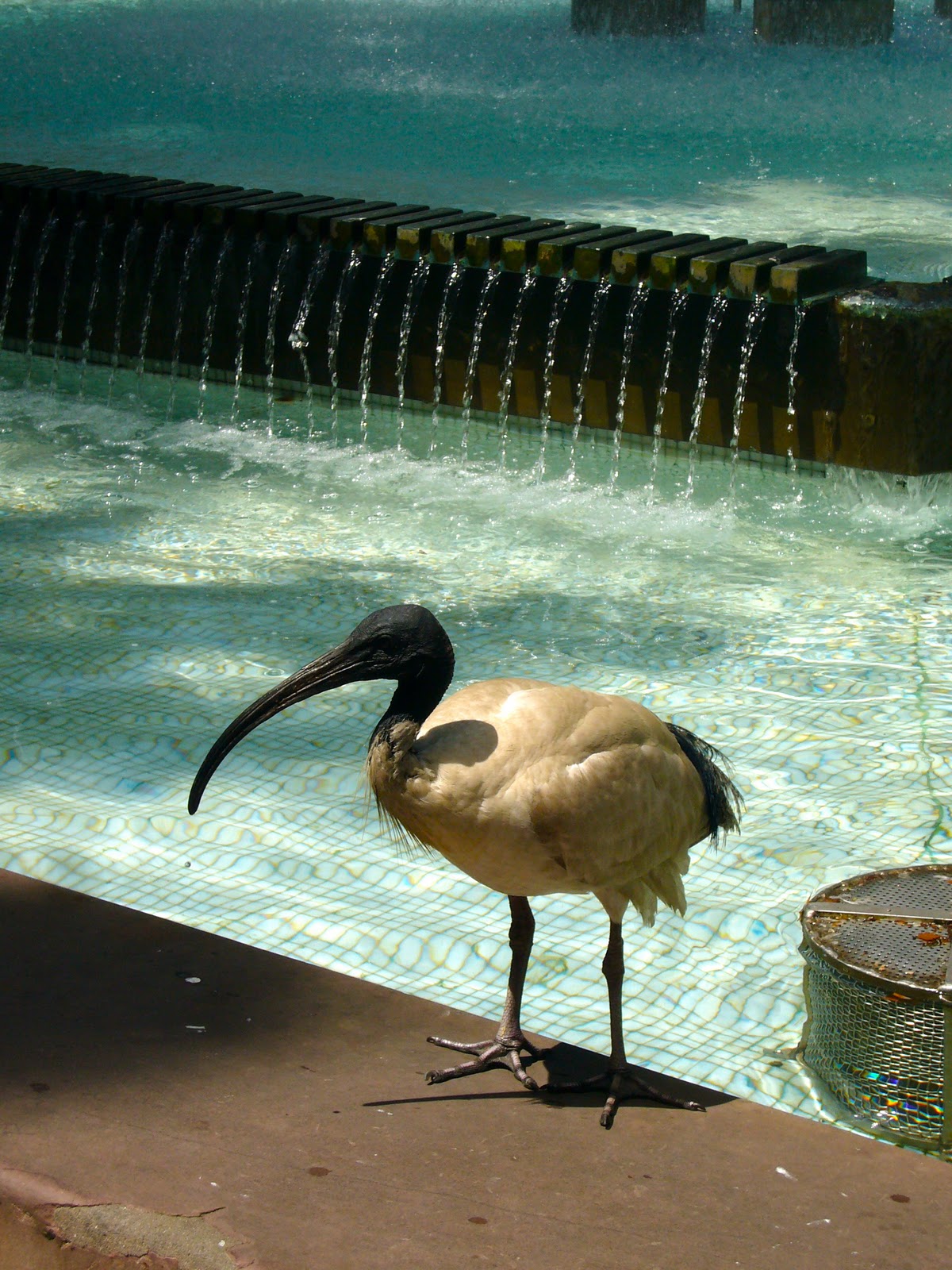
There's been a lot of talk in the neighbourhood recently about Ibis poo. The droppings of this big white bird are apparently one justification for the City of Sydney council's proposed redevelopment of Fitzroy Gardens in Kings Cross. It seems many residents can't bear the white Jackson Pollock-style sprays of Ibis excrement splashed about the gardens.
Sure, there are bird droppings here and there, but in all the times I have been in Fitzroy Gardens I have never actually been hit by an Ibis projectile (although I have been shat on by a pigeon).


I was discussing Ibis and Ibis poo recently with some friends, as we sat just metres away from one's nest in Fitzroy Gardens, and it made me realise I knew very little about the bird at all. 
Call me a fool, but I thought they migrated from Egypt during their northern hemisphere winter and returned home in time for summer. Because of this I had always thought they were such exotic, worldly birds. But the Ibis I was thinking of was actually the Sacred Ibis (Threskiornis Aethiopicus), which was worshipped and even mummified by Ancient Egyptians, who saw the bird as a symbol of the god Thoth, the patron deity of knowledge, writing, scribes and secrets.
Ancestors of this mythical bird now reside in sub-Saharan Africa and south-eastern Iraq and don't carry suitcases or Australian visas, preferring instead to build stick-nests in Baobab trees by the edge of waterholes in their homeland. They are also said to eat frogs, insects, small mammals and, curiously, other birds.
The Kings Cross Ibis is from the same family but seems to enjoy eating anything it can scavenge out of public garbage bins, much like rats do.


The Kings Cross bird is actually known as the Australian White Ibis (Threskiornis Molucca) and originates from inland Australia, according to Michael Morcombe's Field Guide to Australian Birds.
In NSW the birds liked to splash around the Macquarie Marshes in the northwest of the state but in the late 1970s, when inland Australia was ravaged by drought, the water-wading birds began migrating to coastal cities such as Sydney, Wollongong - on the NSW south coast - and even the Gold Coast in Queensland.
Hungry and thirsty after living in drought affected areas, the Ibis set up their Sydney nests in places like Centennial Park and the Royal Botanic Gardens, where water was plentiful and food could be pinched from groups of picnickers or nipped with their long beaks out of open garbage bins.
In the late 1990s, when drought again hit inland Australia, there was another Ibis push into the cities and their growing population began to disturb some residents.
City people couldn't bear these feral country birds' pungent smell or their nosy nature and began to regard the poor, refugee Ibis as a pest. 
During the early part of the 21st century, local councils conducted culls of the birds in the Royal Botanic Gardens, Centennial Park and Darling Harbour, in which Ibis nests were dragged out of trees and the eggs crushed. In Bankstown, in Sydney's west, a professional pest exterminator was called in to shoot Ibis that were living on an island at Lake Gillawarna.
This extreme action prompted animal behaviourist, Ursula Munro, from Sydney's University of Technology to speak out on behalf of the birds:

''They are in trouble and we need to look after them,'' Dr Munro told The Sydney Morning Herald in 2006.
''It may be that the only viable colonies we have are the ones in the big cities at the moment.
''Theoretically, if we keep on destroying them we could force these birds into extinction.''

In 1998, there were 11,000 breeding pairs of Ibis in the Macquarie Marshes and two years later, there were none. And even though the drought is now over, they haven't been back to the marshland since.
A 2006 count suggested there were just 3500 Ibis living in Sydney, but Dr Munro told the Herald their numbers were much less. So where have all the Ibis gone?
Frankly, I don't care about Ibis poo anymore, I just care about the poor, unloved, native Ibis.

Across the Border: Kings Cross: Street Sign


Street Sign at Taxi Rank on Macleay Street.

Monday, November 8, 2010

Darlinghurst: Food: The Victoria Room


My dear friend, Teddy, calls me up.
''Violet, meet me around the corner at the Victoria Room,'' he says.
''Teddy! Are you bonkers? The Victoria Room?''
''Yes, the Victoria Room,'' he says.
''Be there as quick as you can!''.
Then he hangs up.
Bloody hell. Now I need to put on a posh frock and some ridiculous heels and swing on down to that swanky place.
For all the years I have lived in Darlinghurst, I have never been to The Victoria Room.
But I've heard plenty about it and seen the pictures in the local press.
It's all kitted out in faux Victorian Empire furnishings and serves high tea on a Sunday.
And I've seen the sheilas that loiter outside, puffing gaspers in-between cups of Earl Grey. Bottom grazing skirts, high heels, spray-on tans and blow dries.
Not my kind of place.
But it's Teddy and he is such a darling bear, so I pull out the frock I wore to the last wedding and the heels I bought in a moment of madness but have never worn, and teeter on down the street to the Victoria Room.

It's lunchtime on a sunny, blue sky Sunday but when I enter the Victoria Room and make my way to the top of the stairs, I find the room is quite dark, cosily lit. 
I'm greeted by a woman in a striking floor-grazing, halter-neck dress, made of crisp cotton with wide red and white stripes. She looks just like that underwear model with the face like a meerkat, Miranda Kerr. The pretty meerkat hostess gives me a warm, genuine smile and leads me to a far corner of the large room.

We pass plenty of empty booths, until we reach a small, private area that is separated from the rest of the room by a bamboo curtain, and there is Teddy, perched on an antique chair with carved wooden armrests, looking mightily pleased with himself for having commandeered such a wonderful spot.
A ceiling fan turns overheard, moving around the humid air, and a 1940s chanteuse's voice sings foggily from a hidden speaker. Teddy rises from his chair to greet me.
''Oh, Violet, I'm so pleased you came to meet me,'' he says.
''I have a very important proposition to make. But first, some tea.''
I give him a kiss and sit down on a high-backed, grandly-designed chair.
I feel Queen-like, judging all that come before me.

A dashing, dark-haired waiter appears and hands me a tea menu. So much to choose from; there are about ten teas listed and the descriptions make them all sound divine.
I feel as if I am in some Indian mountain town during the servant and gin and tonic days. So I order Darjeeling. And Teddy orders a bottle of Champagne.

The tea arrives in a clutter of cups and saucers and soon after, our high tea lands on the table too.

I nibble on a sandwich and then a scone, as Teddy tells me about his week.
Teddy works as a court reporter for The Daily Beast, a Sydney tabloid that publishes spectacular beat-ups, yet still manages to land all the scoops.
''So I am sitting there in the court room on the first day of the trial, checking out the jurors. I've told you about juror-love, haven't I?'' asks Teddy.
''Sometimes jurors, having spent so much time together over a long trial, end up falling in love.
''On that Brent Steward trial, you know, the sports-chap who was accused and then acquitted of molesting a neighbour?
''Well, apparently two of the jurors ended up together. All the reporters could see that love was blossoming.
''Anyway, as a trial drags on, it's not unusual either, for reporters' attention to wander to that beautiful female juror sitting amongst the riff-raff . . . she sits there, occasionally chewing her pen, or posing a look of concentration to prove she is paying attention to proceedings and to be in the judge's good books,'' Teddy continues.
''Once there was this juror who was absolutely stunning and as she left the courthouse, a couple of camera-men took her picture, even though that's highly illegal - dirty bastards.
''Although I have fancied a number of jurors over the years, I would never dare approach them.
''Last Wednesday, after court was adjourned, I found myself standing on the train platform at Museum - near the Downing Centre court building - with six jurors from the trial I had just been covering.
''It was only the first day of the trial and the Crown had made some gruesome allegations during their opening address.
''It was disturbing stuff and there I was, right next to half the jury, wondering if they were as shocked as I was, but unable to say a single word.''
Teddy carries on like this for a long while, until I just have to distract him for a brief moment.
''Hey, Teddy, see that picture on the wall - the hunting party - it's just like a series of place-mats my grandparents used to own,'' I say.
''Why do artists like hunting parties so much?''

Teddy glances at the picture, and then rants on for the next 30 minutes about how artists probably initially began capturing such scenes because they liked painting the huntsman's red coat and then later, they maybe became interested in themes of death, man versus beast, that kind of thing.
I have another scone as he carries on. During this discourse a sweet-looking young woman from a nearby table, moves in and pinches a sandwich from one of our plates. Teddy and I just shrug and continue on with our hunting-themed conversation.

The scones are delicious - still warm from the oven - and the crust-less sandwiches, which include fillings of cucumber or chicken, cream-cheese and watercress, are surprisingly substantial. There's also an array of miniature sweets, including cups of chocolate with ganache and little cheesecakes.
I am happy with my endless pot of Darjeeling too and Teddy appears very smiley indeed with his bottle of Champagne that is moving ever closer to its last drop.
He is also starting to look a little flushed and blurry-eyed and I start dreading the ''important proposition'' he brought me here to make, so I excuse myself to check out the bathrooms.
You can always judge a place on its bathrooms and while the Victoria Room's rooms do not meet my grand expectations, they are suitable.

I particularly like this hand painted mirror:


I also like the Aesop brand liquid soap. So I wash my hands twice. And then one more time, just for the hell of it, before making my way back to our nook.
As I pass the long bar I have a good view of the restaurant room where I notice the customers are an eclectic bunch. There are the young bronzed women, but also loads of older ladies, wearing pearl necklaces and their best skirt and cardigan combo, all sipping tea and Champagne and looking like they are having a marvellous time. I am really starting to like this place.
But when I arrive back at our table, Teddy is lying comatose from too much Champagne.


Good grief, I think. So I call for the bill and when it arrives, I slide it under Teddy's arm and then I slip downstairs and out the door. Out in to reality and the blazing daylight.


*
The Victoria Room
235 Victoria Street
Darlinghurst NSW 2010
02 9357 4488

Saturday, November 6, 2010

Darlinghurst: Heritage Items: Terraces at 204-218 Liverpool Street

Terraces: 204-218 Liverpool Street
- Register of the National Estate, City of Sydney Council Heritage List
This neat set of nine mid-Victorian Gothic terraces, originally with six rooms, were built between 1860-70. Each terrace has two floors and a basement, so you could house grandma downstairs. There seem to be loads of this style of building in neighbouring Surry Hills, but not so many in old Darlinghurst. Some of them have been rendered, while others just have freckled, ugly brown brick.
In real estate jargon, these terraces are ''tightly held'', and last appeared on the market in 1997, when number 216 sold for $207,000 (no doubt, a ''renovator's delight''), while in the same year number 212 went for $688,000.
As an aside, Australian motorcycle-racer Wayne Gardner owns an apartment in the dark-grey building next door, at 220 Liverpool Street. But you probably didn't need to know that.

Friday, November 5, 2010

Darlinghurst: Plant Life: Spring Flowers

We are now in the third month of Spring, but in Darlinghurst the temperature has dropped, rain is drizzling and the winds are howling through the Plane trees. I can only recall three sunny weekends this season and that fills me with sadness. I love basking in the sun and singing through the streets on a deliciously warm day, but so far there has been very little of that going on.
Nevertheless, Darlinghurst is still spotted with spring colour, from the Daleks at the Darlinghurst Road and Victoria Street crossroads, to the fragrant colour at St Johns Church and the flowers in residents' gardens.
We may live in the inner-city, but Spring in Darlinghurst is blooming, proving you don't always have to flee the city or seek sanctuary in the Royal Botanic Gardens. You just need to keep your eyes open for bursts of pleasure.
Over the past few weeks I have gone blooming bonkers and have photographed the flowers that light my little heart, including these gorgeous Peonies (Paeoniaceae) - in the picture above - which were perched outside in all their splendour at PoHo florist on Macleay Street in nearby Potts Point.
I have listed all the flowers with their family name (to make me sound intelligent) and have also included pictures of cut-flowers purchased at local markets that have brought my apartment to life. Maybe Mother Nature will hear my prayers and praises and grant us with a sunny, flower-filled weekend.

*

The First Flower I Can't Identify, Discovered on Darley Street (Unidentifiaceae):


Darley Street Yellow Hibiscus (Malvaceae):


Darley Street Yellow Roses (Rosaceae):


Darley Street Crimson Roses (Rosaceae) at Blossom Gardens Nursery:


Royston Street Red Begonias (Begoniaceae):


Royston Street White Primulas (Primulaceae):


Royston Street Small Purple Flowers (Unidentifiaceae):


Nimrod Street Rambling Yellow Flowers (Unidentifiaceae):


Royston Street Sunrise Clivia (Amaryllidaceae):


Royston Street Pale Pink Begonias (Begoniaceae):


Royston Street Exotic Pink Begonias (Begoniaceae):


Kings Cross Police Station's Yesterday, Today and Tomorrow (Brunfelsia Bonodora):


And Indoors . . .
Kitchen Window Violas (Violaceae):


Bathroom Daffodils (Amaryllidaceae):


Dining Table Trio of Pink Orchids (Orchidaceae):


Spare Chair Oriental Lillies (Liliaceae):


And My Favourite Flower, Side Table Sweet Peas (Fabaceae):


*
PoHo
117 Macleay Street
Potts Point NSW 2011
02 9331 4333

*
Blossom Gardens Nursery
112 Burton Street
Darlinghurst NSW 2010
02 9361 4786

Wednesday, November 3, 2010

Across the Border: Kings Cross: Fitzroy Gardens

This Saturday there is going to be a rally in Kings Cross to protest the City of Sydney council's plans to redevelop the Fitzroy Gardens on Macleay Street.
The plans also include redevelopment of Lawrence Hargrave Reserve, which is located across the street on the top of the multi-storey car park on Elizabeth Bay Road.
Fitzroy Gardens is home to the famous El Alamein Fountain - which, like the Coca Cola sign, is almost a logo for Kings Cross - and on weekends hosts a food market (Saturdays) and a flea market (Sundays), so it attracts a lot of locals. The Lawrence Hargrave Reserve, perhaps due to its location, doesn't attract so much foot traffic, although it does have a good-sized rosemary bush, which is handy when you're cooking a roast.
As a result, the rally on Saturday is more a protest against the proposed changes to Fitzroy Gardens, while it seems the council is welcome to do what it likes to the little-used reserve.
The gardens were first established in the 1950s and their present design and landscaping date to 1971.
Prior to that, from the mid-1800s, the gardens's site was home to two large residences, Osterley and Maramanah:

Osterley

Maramanah - admittedly, not a great photo

And in those days Lawrence Hargrave Reserve was occupied by another grand residence, Kinneil:

Kinneil in 1944 with a smart guard of honour of Second Australian Imperial Force soldiers.

The 54 acres that is now known as Potts Point and Elizabeth Bay was granted to Colonial Secretary Alexander Macleay in October 1826 and he lived at Elizabeth Bay House after construction was completed in 1839. From 1841 Macleay's land was subdivided and sold off.

Osterley was built in the mid-1850s as a home for barrister Edward Broadhurst and wife, Harriet, and the family remained there until 1894 when it was then tenanted to various people including hotelier Charles Roberts, gynaecologist Joseph Foreman and Chief Justice of the High Court Adrian Knox.
The property was demolished in 1927 and the site was used for recreational purposes including miniature golf and tennis.

Maramanah was built earlier in the 1840s for shipping merchant William Deloitte but when he defaulted on his mortgage in 1850 the house was bought by Anna Challis, whose husband, John, later left a significant sum to the University of Sydney.
Politician Arthur Hodgson purchased the property less than a decade later but only kept it for a couple of years before selling to Thomas Farrell, who leased it out for the next 20 years or so.
Later owners include Edward Sparke (he named it Maramanah) and the Hollander family, who featured in Robin Dalton's 1965 memoir, Aunts Up the Cross.
In 1943, the grand residence was requisitioned for use as a recreational centre for US Navy personnel and a couple of years later became the canteen for the Royal Navy.
After the war, in 1946, Maramanah made the headlines when returned servicemen illegally moved in to the property, saying they had nowhere else to live. Supporters rallied outside and made public appeals for furniture and cooking utensils for the squatters. The squatters were accused of being Communist agitators, as the political party hosted a number of meetings at Maramanah during this time.

Kinneil's history is not as colourful. The big stone house was built for wine merchant John Brown in the 1840s and later owners included department store king David Jones, P&O Company shipping agent Henry Moore and railway contractor Robert Amos, who subdivided the property, creating Barncleuth Square.
Elizabeth O'Connell bought the house in 1913 and subdivided again to create eight blocks for apartments and later turned Kinneil into a guesthouse.
In 1943 Kinneil played host to the Australian and Allied Officers Club, providing accommodation and meals to more than 100 men.

It hard to imagine all that now, as there is absolutely no physical trace of these buildings's existence. By the 1930s Potts Point was the most densely populated area in Australia - a title retained today - and there was increasing demand by residents for greater amenities and recreational space.
The council responded to this need, and over the next two decades began purchasing at great expense the three properties discussed above, and Fitzroy Gardens was built in stages as the land was acquired.
The El Alamein fountain, designed by Robert Woodward and Phil Taranto (from Bankstown, in Sydney's west), was installed in November 1961 and named to commemorate the Ninth Division of Australian Imperial Forces and their famed victory in Egypt during WWII.

By 1968, when this photograph was taken by Beverley Clifford, Fitzroy Gardens was a popular community asset. But its haphazard design and dust-bowl effect created by large expanses of grass led to calls for a proper development of the park, incorporating all its varied spaces.

German and Latvian educated Ilmar Berzins was responsible for the project.
Berzins was the first qualified landscape architect to practice in Sydney and his designs, which include the Sandringham Gardens at Sydney's Hyde Park, were in the Modern European style.
Berzins's plans included building a better link between the El Alamein fountain and the rest of the park, as well as raised garden beds in hexagonal shapes made of convict sandstone brick. The bricks were laid specifically to highlight the indents of the worker's excavation tools.
The work was completed in 1971 and for the first time the park's disparate elements were combined in one unified design.

For forty years Berzins's Fitzroy Gardens have provided a sanctuary and meeting place for locals as well as attracting millions of tourists who seek to rest their weary feet on its benches and photograph themselves next to Kings Cross's landmark fountain.
Even thirty or so years after it was designed Berzins's garden began hosting a Saturday food market, that started with small crowds and now attracts visitors from outside the area. The gardens, with their meandering paths and secret spaces are a perfect home for market stalls.

But then the City of Sydney council, after stripping all character from Taylor Square with vast sheaths of grey granite, wanted another project to work on. In 2008 they began surveying locals about what they did and did not like about the Fitzroy Gardens.

An ''Intercept Survey'' from November of that year, in which 48 people filled out a workbook detailing their desires and dislikes, found that most liked the park just as it was.
There were a few complaints about Ibis poo and cracked paving stones but most wanted to retain the design of the park and the location of the stalls at the Saturday markets, and they certainly did not want any trees removed.

But the council is running ahead with their $9 million vision to homogenise the city and when they have finished, a visit to Fitzroy Gardens, could feel like a trip to Pyrmont or Circular Quay or Taylor Square. It will lose its identity.

The council's plans include demolishing Berzins's carefully placed convict bricks . . .

The removal of Berzins's palm grove . . .

And the razing of Berzins's artfully designed raised garden beds . . .

. . . to create a bland, flat space, paved in the council's signature grey granite.

The proposed construction also risks upsetting the root system of the 100-year-old Ficus tree in the picture above.

According to the council's concept plans their ''vision'' for Fitzroy Park is to ''tame the many levels of the park . . . the general sense of disorientation''.
But that complaint never cropped up in their Intercept Survey.
And you have to be suspicious of the council's motivation - and worried about their abilities - when they throw around sentences such as these:

''Our challenge is to reconcile two seemingly opposing impulses. Once (sic) to unify the space and to give is (sic) an urban order and a singular identity, the other to find within this organization (sic) spaces that are rich, intimate, robust and diverse.''

I'm opposed to the council's plans because if they go ahead Kings Cross will lose an integral part of its identity and, even more importantly, its heritage.

The 1970s provided few gifts in terms of architecture in Sydney, but Berzins's garden design is still appealing and is still functional. Berzins should be commemorated for this and his Kings Cross garden should not be destroyed.
When we in the 21st Century, start deriding our recent past and removing all trace of it, what will be left in 100 years time to prove that Australians and new migrants were actually capable of good design in the 1970s?
But the council wants to erase this real heritage to instead celebrate a contrived history by design-checking Alexander Macleay's butterfly and bug collection housed in the Macleay Museum at the University of Sydney:

''Still Fitzroy Gardens will recall its formative past. The jewel-like curios of the Macleay collection inspiring the material's palette, beautiful glistening pavements, custom seats winged like butterflies or petalled and open to conversation.
''While tiled benches with fluted bases incised like the brass weir on El Alemain fountain draw on more recent histories.
''Combined with arching palms, strange and unusual plants, Fitzroy Gardens will once again be wonderful place (sic), matching a grand and bohemian past with this future renewal.''

So the council wants to spend $9 million on glistening pavements, seating with butterfly wings and strange and unusual plants, but the Ibis will still continue to shit on it anyway.
The Friends of Fitzroy Gardens* is opposed to the council's plans and resident and member Michael Gormly, has built an entire website devoted to the cause. (He also has a blog devoted to the hood, called Kings Cross Times.)
Gormly spent most of last Saturday manning a small desk at Fitzroy Gardens to alert residents to the proposed development and encourage them to sign a petition against the plans.

Michael Gormly

Some people I spoke to at the markets scoffed at the idea that the garden-bed bricks were made from convict stone, that the palm grove was being removed and that the Ficus roots could be damaged during construction. They accused Gormly and Co of having ulterior political motives. But I have looked at the council's plans, including the heritage assessment and the arborist report, and they truly are convict stones, the palms are being removed and the Ficus roots could be damaged (''May result in some root severance damage leading to an adverse impact.'').

The more I learn about Fitzroy Gardens, the stronger I feel about not wanting to see this beautiful, character-filled place bulldozed and turned into some hideous cookie-cutter Cockle Bay style tourist attraction.

The Friends is organising the rally, which is being held this Saturday at Fitzroy Gardens from 11am. Visit the Save Fitzroy Gardens website for more details.

*The Friends is a coalition of local business and resident groups including The Potts Point Partnership, the 2011 Residents Association, Potts Point and Kings Cross Heritage Conservation Society, Darlinghurst Residents Association, the Kings Cross Arts Guild and the Kings Cross Community Centre.


Tuesday, November 2, 2010

Darlinghurst: Heritage Items: Terraces at 337-345 Liverpool Street

Terraces: 337-345 Liverpool Street
- Register of the National Estate, City of Sydney Council Heritage List
I probably would have walked straight by this ramshackle row of terraces if I didn't know they were listed on the Register of the National Estate, as they look like most residential buildings around Darlinghurst.
I assume the reason they are on the prestigious register is because at some point, post 1975, the buildings came under threat from the wrecker's ball - much like Iona did - and therefore the National Trust or other heritage groups campaigned for them to be included.
They are also quite old for the area. Number 337, in the very right of the frame, is a three-storey mid-Victorian sandstone terrace from about 1860. It has ten apartments, one of which was recently listed for sale at $595,000. The real estate agent described the two-bedroom apartment as ''featuring house-like proportions and brimming with historic charm''. Other pluses includes a feature fireplace and Spotted-Gum floors.
Terraces 341-345 were built even earlier in the Victorian Filigree-style and have not been converted into apartments.