Showing posts with label Taylor Square. Show all posts

Tuesday, April 23, 2013

Darlinghurst blog: Lost and Found: Red Cat

This poster was pasted up at Taylor Square. It's your classic 'Lost Cat' poster, except the choice of pet photography is rather interesting. Someone suggested the cat wouldn't be hard to find with its 'demonic' eyes. Has anyone seen this flashlight-eye feline?

PS. In a bid to explore new blogging frontiers, I'm writing this post on that new whiz-bang mobile phone technology, which may also add a certain weird quality to the format. Basically, it won't allow me to put the pic at the top of the post! Any hints?

Thursday, April 11, 2013

Darlinghurst Blog: Detritus: RIP Rainbow Crossing

There was disappointing news this morning that the rainbow crossing at Taylor Square was ripped out last night by the NSW Government. 
The bright, vivid colours - and what they represented - were such a welcome addition to Oxford Street and really brought the road to life, making it a destination for residents and tourists.
The crossing was put in place by the City of Sydney to mark the 35th anniversary of Mardi Gras in March.
But the state government refused to let it remain due to safety concerns and removed it at 10pm last night.
It's so sad that it's now gone and is just a memory.
You can read news stories about its removal here, here and here.
RIP rainbow crossing.

Sunday, March 25, 2012

Darlinghurst Blog: Heritage Items: Taylor Square Underground Mens' Conveniences

Hanging about in a men's public toilet is not how I would normally spend a day like yesterday, when the autumn sun was shining and the sky a brilliant Sydney blue.
But I jumped out of bed, rushed through my Saturday morning house cleaning and fled out the door before 11am, for the chance to explore the underground men's conveniences at Taylor Square.  

 
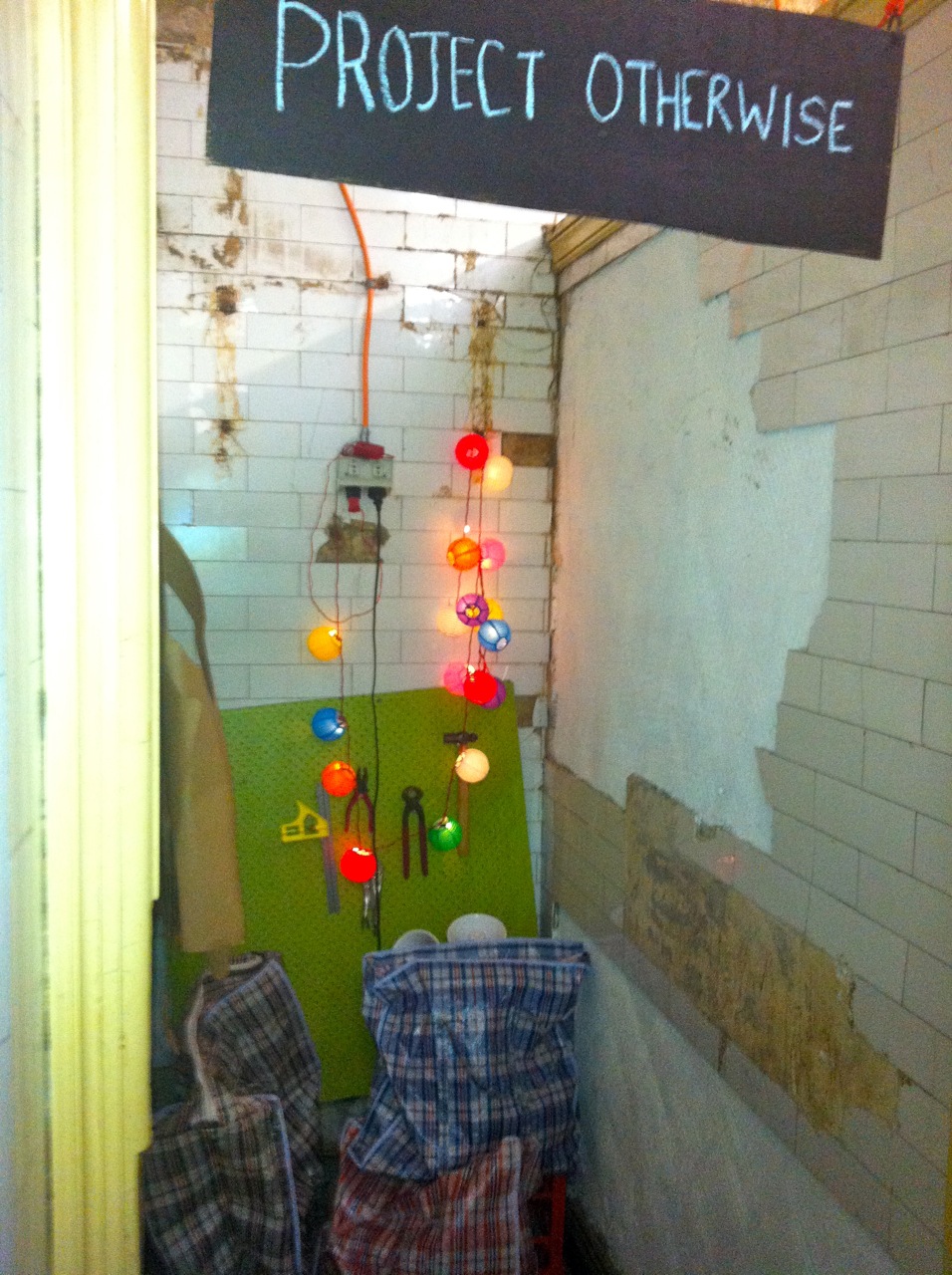
The 1907 toilets closed to the public in 1988 but opened briefly yesterday for a public art project, A Leaf From the Book of Cities, by Makeshift, a creative collaboration between Tessa Zettel and Karl Khoe. 
The installation has been open the past three Saturdays, between 8am and 1pm, with the final opportunity to experience the work this Saturday, March 31. 
A Leaf From the Book of Cities is made up of a handful of installations in the old toilet stalls and urinal areas, which are designed to make you think about the "possibilities of a quality-based economy". 
If that sounds a bits arts wank, it essentially means alternative ways of obtaining everyday items: food, clothes, books, real estate et al.
But even if you aren't interested in such ideas, it is worth a visit just to see this heritage-listed underground toilet.


The Taylor Square toilets were one of ten underground conveniences for men built by the Municipal Council of Sydney between 1901-1911, due to sanitation concerns following an outbreak of the bubonic plague in Sydney in 1900. 
Previously on the site there was an 1880s public urinal with a steel roof holding tanks of saltwater, which was used for street cleaning. 
Following the health concerns, the toilets were built underground because it was considered unhygienic for men to be relieving themselves on street level.
Placing the toilets underground was also more aesthetically pleasing and their construction coincided with the City Beautiful movement, which drove the push for the remodelling of Oxford Street and the establishment of Taylor Square.


The opening of the toilets also came four years after the neighbouring electricity substation (known as number six) was switched on.
The substation, also heritage-listed, was built following the introduction of the Electric Lighting Bill in 1896, which required the council to provide power for street lights and residents' homes.
It was an important and exciting time in Sydney's history, with the massive technological advance - that we take for granted today - changing the way people lived and worked forever.
The substation, which was used right up to 1993, also provided power for the new electric trams that cruised down Oxford Street.

1930s Taylor Square, source: City of Sydney Archives

Taylor Square was an important tram junction in those days, and the underground men's conveniences were used by hundreds of commuters, which is why there is about ten urinals and five stalls.
Designed by city surveyor and architect Robert Hargreave, the "Edwardian Civic" style toilets feature a wrought iron fence and gates with art nouveau detailing above ground, which lead to two interlocking curved staircases that take you underground to the white-tiled toilets.


While the urinals remain, the toilet bowls and sinks have been removed. 
In the washroom area yesterday there was a small table holding a large pot, jam jars and books, and seemed to suggest that we should all start buying produce in season and making our own jams and preserved fruits for the off-months.


The first stall had some of those tartan laundry bags, colourful lights, tools and dressmakers' blocks to perhaps encourage people to start making their own clothes and building their own furniture. 


The "6 Jars" stall was an interesting concept. It's an idea that encourages people to think about what they eat, befriend their neighbours, and buy less packaged food. 
To put that into practice it asked people who live locally to sign up and they would be introduced to five like-minded locals who they could share food with. 
So you cook up "a batch of goodness" put it into six jars and share them with your new friends; they in turn do the same and you only need to cook dinner once a week. I quite like the idea.


I'm not certain what the Librarium stall was about, but assume it's to encourage people to share their libraries, which I often do anyway.  


At the end of the five stalls is another urinal area, which yesterday was home to typesetters' tools and an old fashioned printing press. 


The Makeshift art duo plan to print a little mini-mag or zine featuring sustainability ideas that arise out of a workshop that runs parallel with the installation in the neighbouring above-ground women's conveniences, which are housed inside the substation and were built in 1938, following much lobbying by women.
I wasn't allowed to sneak a peek in the women's because apparently its where stuff is stored for the Saturday markets and the market folk didn't want any old riff-raff snooping about in there.
But I was more than happy to have seen the men's conveniences, which closed in 1989, because of safety concerns.
The toilets are special because they are the last remaining of the ten men's underground toilets. 
The others were gradually demolished over the years, including as recently as 2003, when the City of Sydney council, under Lord Mayors Frank Sartor and Lucy Turnbull, demolished the lavatories at Hyde Park, Macquarie Place and Wynyard Park - despite protests by the National Trust and others.
Now that the Taylor Square men's conveniences have been heritage-listed, the question is, what to do with them?


*
SOURCES: 

Tuesday, October 11, 2011

Darlinghurst Blog: Detritus: Sydney Rides Festival Part II

I was determined to make it to the Sydney Rides Festival launch on Saturday but on the way to Taylor Square, I bumped into Ralf and Digger* and a bunch of other friends so that I only made it to the bike fair about 2pm. And by that time, most of the produce stalls from the Saturday Sustainable Markets were packing up, leaving a curious array of cycle-themed stalls.
There were a few men in tight latex pants, but the new breed of hipster cyclists were mainly represented with clothing stalls for the "Stylish Urban Cyclist", such as the one for CycleStyle (above), which sells reflective tweed cycling capes, iPhone-friendly riding gloves and "skirt garters" for holding women's hems in place. 


Cyclette (above) is another dedicated bicycle fashion label, which specialises in "sexy girls cycle wear for on and off your bike". Their designs include "Granny-Flashers" bloomers, strapless mini dresses, as well as handle-bar bags and fingerless gloves.


The cycling sub-culture is a curious thing; I didn't realise its followers were so dedicated. I was discussing the cult-like nature of bike-riders with a friend on Saturday when she told me the story of one of her old boyfriends. She said he became strangely obsessed with cycling and used to look with envy at the latex-clad cyclists who populate the Victoria Street cafe strip in the mornings. One day, he said, he would be lycra-clad too, and joining the cycling mob on their rides and coffee stops. 
And he achieved that goal eventually too. 


That old boyfriend would have been over the moon on Saturday. He could have bought back issues of dedicated bicycle magazine, Treadlie, or had his bike checked and tuned for free (both above).
My friend Ruby Molteno hasn't used her bicycle in over a year because the rear tyre went flat and she didn't know how to replace the inner-tube. So she took the bicycle along on Saturday and had it repaired for free. But because she is such a good person, she insisted on buying the cycle repairers coffee and muffins. Now she is hooning around the neighbourhood on two wheels. Look out pedestrians!


There were also electric bicycles (below), which cost about $2000. I took one for a test drive once when they had a stall at the Kings Cross Saturday Markets and it was fast and hilarious, and a little bit lazy too as I imagine I would initially use the motor for hills but would eventually become addicted to motor-driven sweat-free, non-pedalling.


Child cyclists were also going nuts at the festival and I was almost run over by a few:


CBD-based bike shop MC Cyclery set up a Games Arena for the day, which was mainly hogged by male cyclists playing some bike-back version of polo:


There were also a few deck chairs (below) for lazing in the sun. The same deck chairs arrived yesterday at Sydney Square next to Town Hall and the square next to Wynyard train station and will stay around for the next six months giving office-workers and other city habitue somewhere to relax. 


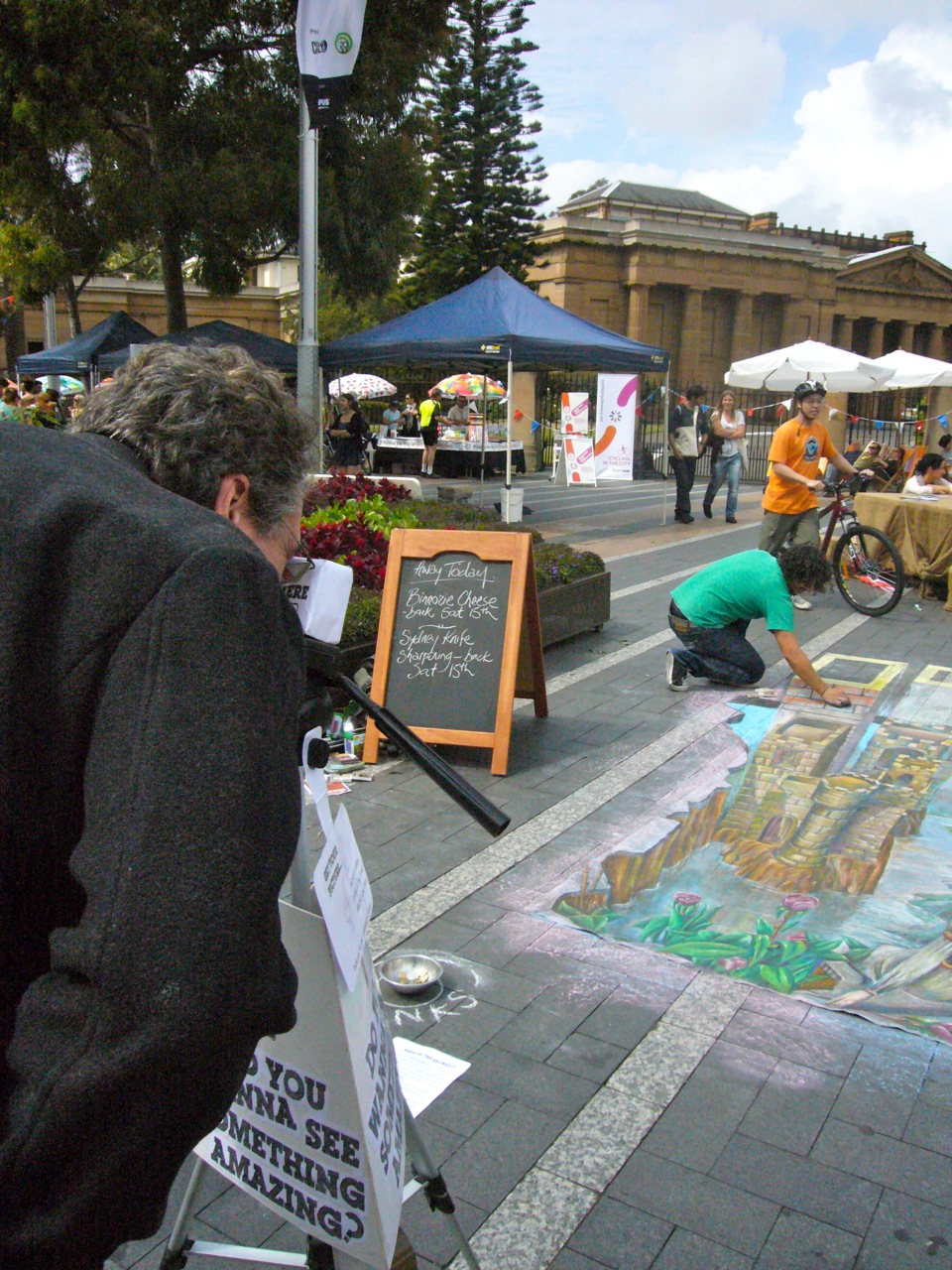
One little interesting thing that caught my eye was the chalk artist busker:


I've seen a fair bit of chalk art in my time but never have I seen this 3D version, which only works from a single viewpoint that the artist has set up on a tripod. It was very clever:


The fair was interesting but there wasn't as much live music as promised and when I arrived there was only one food stall selling tandoori wraps. If you like food stalls, check out the Night Noodle Markets at Hyde Park North, which opened last night and runs every weeknight from 5pm - 9pm, until October 21. I went once years ago and was disappointed but last night I popped in to discover that there are loads more quality stallholders as well as beer tents and DJs. 

*
*Poor little Digger is presently recovering from that surgery they give to animals when they reach a certain age and he has been forced to wear one of those funny, plastic Elizabethan-style cone collars, so that he doesn't nibble at his wounds. He looks very cute but I won't post his picture here because I don't think he'd appreciate it.

Thursday, March 3, 2011

Darlinghurst: Detritus: Mardis Gras 2011

This Saturday Oxford Street in Darlinghurst will be closed to traffic to make way for the annual Sydney Gay and Lesbian Mardis Gras parade, now in its 33rd year.
The 16-day Mardis Gras festival launched on February 19 and there have been daily events and performances since then, including Fair Day at Victoria Park at inner-city Glebe, the Lifesavers with Pride beach BBQ and carnival at Tamarama Beach and the Mardis Gras Film Festival. 
United States author Armistead Maupin, who wrote the excellent and addictive Tales of the City series about San Francisco's gay community in the 1970s and 80s, is also giving a reading and being interviewed at a literary event TONIGHT at the Sydney Opera House. Tickets cost between $39 and $59, plus booking fee and you can purchase them here.


Darlinghurst has been abuzz with Mardis Gras fever since the festival was launched. There are loads of gay tourists on the streets taking photographs and holding maps, while there are dozens of posters plastered up around the neighbourhood advertising special Mardis Gras offers and events. 
The first Sydney Mardis Gras was held on Saturday June 24, 1978, as part of international Gay Solidarity Celebrations to promote gay and lesbian rights. You would think we have come a long way since then, but gay and lesbian people still have to fight to gain equality and acceptance in the community. Even in Darlinghurst. 


Peter Madden is the Christian Democrat Party's candidate for the Seat of Sydney in the state election on March 26. Mr Madden - perhaps unsurprisingly given the party's long stance against gay people - is running on a platform that includes putting an end to the Sydney Mardis Gras parade. Madden claims the festival is ''sexually immoral'' and believes the parade is an opportunity for gay and lesbian people to ''recruit'' young people.
Okay, he is completely mad, but I still can't believe people believe this shit in 2011. 
Mr Madden aside, gay and lesbian couples in Australia are still fighting for the right to be legally wed, with many being forced to travel overseas to the United States or Canada, where it is legal, just to get married. 
There was an interesting Crikey article this week, by Tom Cowie, about whether Mardis Gras is still relevant and it's worth reading just for the comments by readers. 


The parade begins at Hyde Park and travels up Oxford Street and then along Flinders Street to Moore Park for the Post Parade Party at the Royal Hall of Industries. The parade consists of over 100 colourful floats surrounded by dancers. Most of the floats have a political or comic theme and some regulars include Dykes on Bikes, Tits on Trucks and Muscle Marys.
I was going to write a potted history about the parade but the Sydney Mardis Gras website has that covered, so instead I will just pull out some interesting little facts and curios about the event, for which this year's theme is Say Something


About 1500 people attended the first Mardis Gras parade. They met at Taylor Square and then marched behind a truck equipped with a sound system down Oxford Street to Hyde Park. They were harassed by police officers along the way because holding such a demonstration was illegal. Many revellers ran up William Street to Darlinghurst Road to escape the police, but instead were met by a road block where officers swooped and arrested 53 people, who were allegedly beaten in the cells.  
It wasn't a good start but it paved the way for legislative change in 1979 when NSW Parliament created a new Public Assemblies Act that allowed people to apply for a permit to hold such a large demonstration.


In 1979, 3000 people marched in the parade. 
In 2009, 10,000 people marched in the parade.
About 500,000 people turned out to watch the parade in 1993.


At the height of the AIDS scare in 1985, the parade was nearly cancelled when the head of Australia's AIDS Task Force controversially appealed to ''the gays to be responsible enough to cancel the Mardis Gras activities''. The parade went ahead but organisers of the Post Parade Party had to pay double for the venue hire to placate the owner.


The Mardis Gras parade was first broadcast on television in 1994 in a 50-minutes highlights special on the ABC. In 1997 the event was broadcast by commercial channel, Network Ten, and this year it will be screened live on pay-TV channel Arena, from 7.30pm.


About 2 million birds worldwide are plucked to provide enough feathers for the Sydney Mardis Gras. 
Sequin factories in China have to work overtime for three months to supply an estimated 20 million spangly sequins for the event.


The Mardis Gras festival attracts thousand of international and interstate visitors, generating an estimated $39 million in tourist dollars for the NSW economy.


Boy George, The Village People, Chaka Khan, Jimmy Barnes, Kylie Minogue, Danni Minogue, George Michael and Cyndi Lauper are just some of the musicians that have performed at the Mardis Gras's Post Parade Party, which attracts up to 20,000 people.
This year the Mardis Gras Party is being held at the Royal Hall of Industries and the Hordern Pavilion at the Entertainment Quarter at Moore Park, but the big act has yet to be announced. 


Darlinghurst's Stonewall Hotel at 175 Oxford Street is named after the original Stonewall Inn in New York's Greenwich Village. The Stonewall Inn was owned by the mafia during the 1950s and 60s and was a popular place for the city's most marginalised residents, including gay and lesbian people. 
On June 28, 1969 the inn was raided by police, who regularly targeted gay bars, and a riot ensued. 
The tensions between the police and gay and lesbian citizens intensified over the following weeks leading to the establishment of resident activist groups that campaigned for equal rights and organised venues where gay and lesbian people could socialise without fear of being arrested.


There are NO car spaces in Darlinghurst on Mardis Gras night, so leave your vehicle at home if you are coming in to the neighbourhood. Just for fun, why not catch the 311 Bus?
P.S. I made up those statistics about the feather and sequins.

*

Friday, November 12, 2010

Darlinghurst: Detritus: Christmas Tree

It's officially Christmas in Darlinghurst!
I took this photograph at Taylor Square this evening. 
Happy Christmas dear readers!
And don't worry, I won't be writing a history of Christmas trees in the area.

Monday, October 25, 2010

Darlinghurst: Street Art: Oxford Art Prize

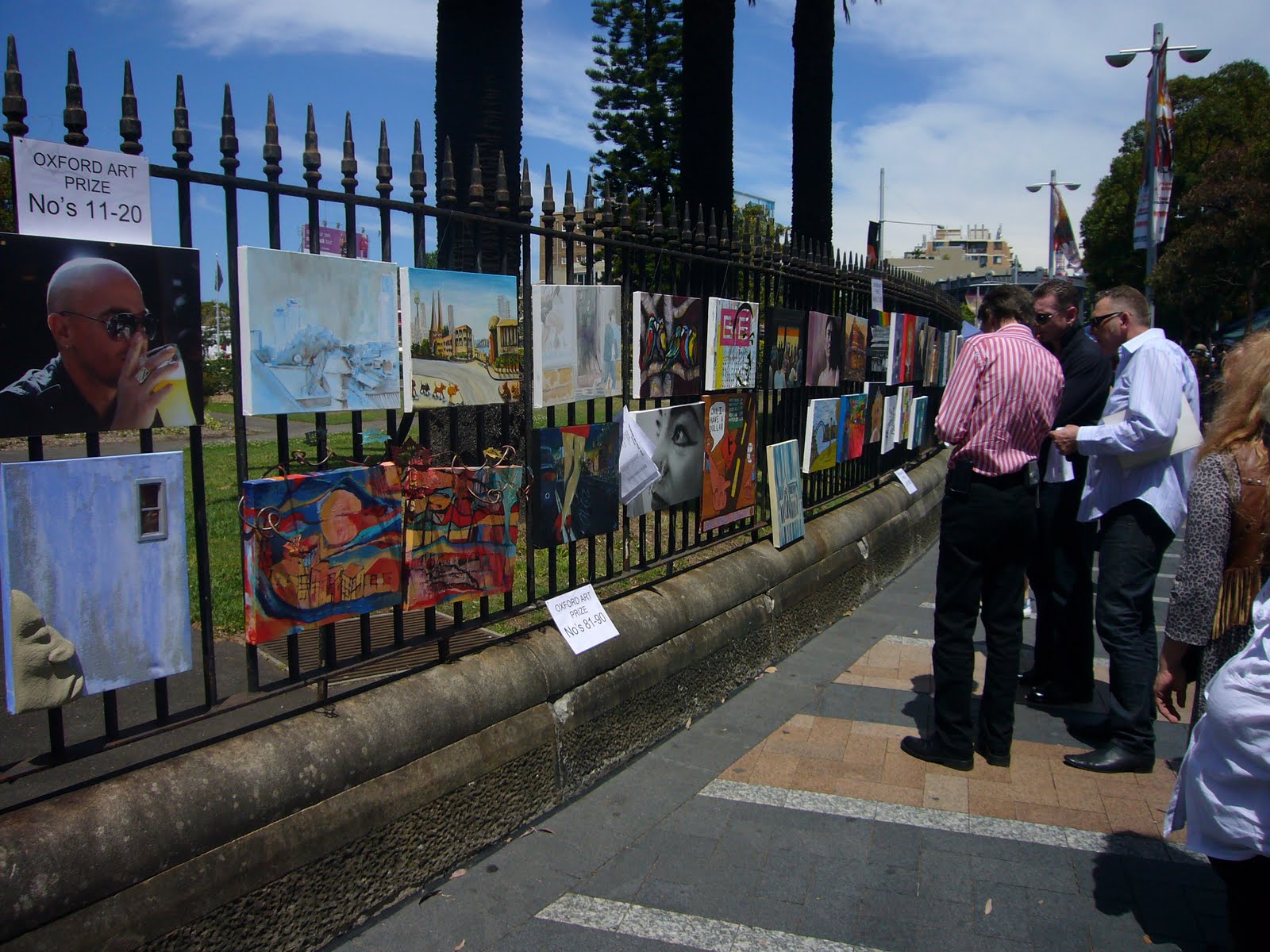
Saturday was sunny and promising so I set out with my friend, Crystal Kaye, to explore the neighbourhood and it wasn't long before we made a discovery: dozens of colourful canvases strung along the fence poles of the Darlinghurst Court House.
The six-hour Oxford Art Prize exhibition, made up of 100-plus works, was part of the Oxford Arts Festival, which runs until October 30.
The inaugural 12-day festival was designed to promote the arts, artists, restaurants and retailers of Oxford Street and Darlinghurst, which is surprising seeing as I had never heard of it.
The festival's online home is this blog that has posted just two stories since April, and has only one follower - even less than My Darling Darlinghurst.
I love a festival, especially if it's local, but it's a shame when they fail on the publicity front and don't attract the punters.
There were even mimes and other performers, including this wonderful band, to entertain the potential crowd:

The outdoor exhibition also coincided with the Sydney Sustainable Markets, which are held every Saturday at Taylor Square, so apart from art, there was lots to look at:

Compact Vegie Garden On Show

Himalayan Orchids For Sale

I'll be writing a more comprehensive account of the markets on a later visit, because on this day Crystal and I were having a fine time judging the art. The Oxford Art Prize also allows the public to vote for their favourite work. We didn't plan on it, but Crystal and I ended up voting for the same painting:

Inside and Outside in Darlo, by David Wilson

Crystal thought Wilson was the most talented artist on show. I liked his absurd characterisations and the painting's sense of debauchery. Wilson's style also reminds me of the work of veteran newspaper cartoonist and illustrator Bruce Petty.
Meanwhile, the three real judges - Dean of COFA Ian Howard, the National Art School's Stephen Little and art dealer David Rex-Livingston - were busy scratching their chins as they tried to pick a winner:

Crystal and I asked the man manning the desk when they were going to announce the winner, because we had other adventures to carry-out. But he was a bit vague and only said it would be announced between now and 4pm. Which was about two hours away.
So we wandered off and came back an hour later, asked around and learnt that the winner of the People's Prize was this striking photograph on canvas:

Augenblick, by Mandy Schone

We never learnt who won the Oxford Art Prize and the festival blog so far hasn't announced the winner either.