Showing posts with label Forbes Street. Show all posts

Monday, May 23, 2011

Darlinghurst Blog: Villas of Darlinghurst: Barham

Detail from 1845 painting by George Edwards Peacock.
Barham: allotment of over 6 acres granted to Edward Deas Thomson in 1831.
Register of the National Estate, City of Sydney Heritage List.

I had been meaning to write about Barham as part of my Register of the National Estate series and then the building also popped up in the Villas of Darlinghurst book that I am writing an occasional series about too. So I can kill two blog posts with one. 
Barham was built in 1833 and is the oldest residential building in Darlinghurst. Iona, for example, was built in 1888, while Potts Point's Tusculum - another remaining old villa - was completed in 1836. Elizabeth Bay House was completed in 1839. 
That makes Barham (pronounced Burrum) rather special and one of the reasons that it remains when others villas were demolished, is because it was purchased by SCEGGS in 1900 and has been a part of the school since then.
The grand villa was built for Sir Edward Deas Thomson, who was granted over six acres in the new Darlinghurst estate in 1831. Thomson was born in Edinburgh and migrated to Australia in 1828-29 when he was appointed the dual role of clerk to the Executive and Legislative Councils in NSW on a salary of 600 Pounds a year.
The then Governor Sir Ralph Darling was very happy with Thomson's hard work and competence and granted him the land in Darlinghurst. Architect John Verge was employed to design Barham, which was initially leased to Colonel Kenneth Snodgrass, before Thomson moved in with his wife, Anna-Maria, the daughter of Governor Richard Bourke.
When Thomson left public office he was elected vice-chancellor of the University of Sydney in 1863 and chancellor in 1865, retaining the post until he was forced to resign due to ill health in 1878.
The couple raised their two sons and five daughters at Barham and remained there for 40 years until Thomson's death in July 1879. Thomson was buried at St Jude's Church of England, in Randwick, in Sydney's eastern suburbs.
Thomson's daughter, Susan, married William John Macleay, who was Colonial Secretary Alexander Macleay's oldest son. Alexander was granted 54 acres at Elizabeth Bay and he also employed John Verge to design his villa. William moved into Elizabeth Bay House in 1839 and lived there until his death in 1865. 
It was Thomson's influence, as chancellor of the University of Sydney, which led William to donate his father's important natural history collection to the institution in 1873. The collection remains at the university's Macleay Museum today.
After Thomson's death in 1879, Barham was purchased by members of the Ogilvie pastoralist family who then sold it to SCEGGS in 1900.
Barham is today located just off Forbes Street within the grounds of SCEGGS and can not be viewed from the street. 
But I didn't let that stop me from seeing such an historic building and slipped into the school one day when the gates were open:


The two-storey mansion is built in the Colonial Georgian style from rendered masonry and timber, with a sandstone basement and tiled roof. Alterations were made between 1900 and 1910, which included the addition of the boarders's dining room, kitchen and laundry and the Headmistress's or Head of School's office, which was built onto one corner. In 1836, the shutters on the top floor windows were removed. 


Today it is still used for the administration offices and I believe the boarders's facilities still remain. According to heritage reports, the original configuration and structure of the house is intact and generally in good condition, while original joinery survives in the meeting room, dining room, corridors and main door.


The school's alumni include actress Claudia Karvan, comedians Julie McCrossin and Pamela Stephenson and authors Blanche d'Apulget and Ursula Dubosarsky.

Monday, April 4, 2011

Darlinghurst: Churches: First Church of Christ, Scientist

Darlinghurst is set to be home to a new mansion after a development application was lodged last month to transform the ''First Church of Christ, Science'' building on Liverpool Street into a private residence.
Merchant banker Mark Howard Carnegie purchased the building from the Christian Scientists in June last year for a whopping $8.75 million and has submitted an innovative proposal to the City of Sydney council to turn the church and its massive auditorium into a six-bedroom house using a unique ''pod'' design.
I have to say it is a pretty impressive proposal and a very clever way to convert a 1927 heritage church into a modern home. 
The Inter-war Beaux Arts-style exterior and ''highly significant internal architectural composition'' would be retained and a dwelling ''pod'' would sit ''lightly within the shell of the former church auditorium'', according to the development application.


The pod would include a ''kitchen module'', with a kitchen, pantry, dining room, laundry; a ''guest module'' with two bedrooms accommodating three bunk beds and a guest bath; as well as a living room, three more bedrooms and a master bedroom with ensuite bathroom and dressing room, which would sit above the kitchen module.
I also like the sound of an indoor bamboo garden, which would be planted in shallow, waterproof containers at the southern end of the auditorium.
''The proposal will require removal and storage on site of all but three or four existing rows of seating in the auditorium and will otherwise be essentially freestanding,'' the application says.
Most amazing of all, is that the entire pod will be able to be removed and recycled if the building is ever converted back into a church or auditorium.
''The challenge for the project is not only to be respectful and subservient to the grandeur and eloquence of the original space but also to ensure that all is done in a manner that is fully reversible,'' the application says.
''The new structure will not touch any of the existing fabric other than bearing on the existing sloping auditorium floor.
''It is intended that the majority of work to construct this new insertion will occur off-site, both to achieve time-savings but also to limit potential risk of damage to the existing building.''
The church is also home to a large, Josiah Eustace Dodd-designed, orchestral-style organ that is considered by the Organ Historical Trust of Australia to be one of the most important historic organs from the post World War 1 period in NSW.
''As with the rest of the building fabric (this organ) is to remain untouched, however it is proposed to retain three pews within the space to enable occasional private performances to be held for the groups who have shown particular interest in this instrument and its capabilities.''
Well, isn't that bloody marvellous.
The proposed development for the 2078sqm site is estimated to cost $1.7 million. 
The architect behind this unique concept is Simon Swaney, from Darlinghurst-based Bates Smart, and I highly suggest you read the fascinating proposal - that includes a 63-page conservation management plan and 26-page heritage impact statement by Graham Brooks and Associates - on the council's website here, which also covers the history of this grand building.


But if you don't have time to read all that, let me provide you with a potted summary.
The site, on the corner of Liverpool and Forbes Street was within the original 1800s Edward Riley estate - inherited by Thomas Burdekin - and remained undeveloped until the 1920s. 
During the early part of the 20th Century the site was used by the Burlington Picture Show and hosted political rallies, farewell nights and other events, which were held in a large tent from 1909 to about 1915. 
In 1923, when the site was owned by James Alison and Alexander Hay, it was subdivided and an area of ''one rood, two-and-a-half perches'' was sold to the Christian Science Church.


The religion was founded by American Mary Baker Eddy (above), who became interested in ''healing ministry'', following a childhood bout of illness which was initially cured by a colourfully named faith healer, Phineas Quimby, from the Science of Christ ministry. 
Eddy established her church in Boston in 1875 and by her death in 1910, the church had spread to the majority of English-speaking countries, including Australia. At its peak in the 1930s the Christian Scientists had 3000 churches worldwide. 
In 1898 a few copies of Eddy's Science and Health were in circulation in Sydney and the appropriately named, William Wright Virtue, began hosting church meetings in his home with a handful of people. 
The meetings later moved to a house at 15 Harrow Road, Stanmore, in the inner west, but when numbers increased to about 36 people, the group took over a space in the Queen Victoria Market Building (now the QVB) in the Sydney CBD. 
The church first moved to Darlinghurst in 1916, to a custom built building on Riley Street (since demolished).
''The mother church congregation quickly outgrew the Riley Street accommodation and by 1923 planning was in hand for a much bigger building to house the members,'' according to the DA.
''The site on the corner of Forbes and Liverpool streets was purchased for 9000 Pounds and the architect firm Peddle Thorpe and Walker engaged to design the building.''


The $30,000 development, which included the Sunday School, foyer, pipe organ and furnishings, was built by the Hutcherson Bros and the church officially opened in July 1927.
During construction work, on March 9, 1927, the building was the subject of a lengthy article in the Sydney Morning Herald, which predicted it would be a ''worthy addition to the better type of Sydney's monumental architecture''.


The architect, Samuel George Thorpe, (who later designed Sydney's first skyscraper, the 1962 AMP building at Circular Quay), was believed to be a member of the Christian Science Church.
Thorpe based his design for the Darlinghurst church on the CSC's ''bank-style'' buildings in the United States, of which there were so many in the classical revival-style, they were soon dubbed, ''The Christian Science Church Building Movement.''
''It identifies a certain self-consciousness about the vision of the church, an effort to be perceived publicly as prominent, legitimate, successful and literally profitable to the worshiper, all this making the religious aims of Christian Scientists appear rather superficial,'' the DA says.
''The principal characteristics of building are monumentality and a consequence largeness of scale, symmetry, a thorough consistent application of classical motifs and the use of up to date structural techniques permitting impressive spacial volumes.''
All features of the Darlinghurst church.
The building has changed very little since then. The only minor alterations have included the addition of carriage lights on the outside walls, which were purchased from the old Sun Herald building in the late 1950s. A new entrance door to the reading room on Forbes Street was also added in 1985.


I'm bizarrely excited about the new plans for this site and I hope one day - perhaps posing as an organ aficionado - I can take a look at the pod interior.
I really want to have a peek inside the church before the development begins too. And wouldn't it be great to photograph the final service at the church after 84 years of operation?

*
The exhibition period for the development application closes on April 19.

*
First Church of Christ, Scientist
262 Liverpool Street
Darlinghurst NSW 2010

Sunday, February 20, 2011

Darlinghurst: Street Art: Bogans


''Bogan: a person who takes little pride in his appearance, spends his days slacking and drinking beer.''

Someone has gone to a lot of trouble to make these posters about male Bogans. I spotted this one on the hoarding of the Darlinghurst Court House on Forbes Street.

Monday, October 25, 2010

Darlinghurst: Street Art: Oxford Art Prize

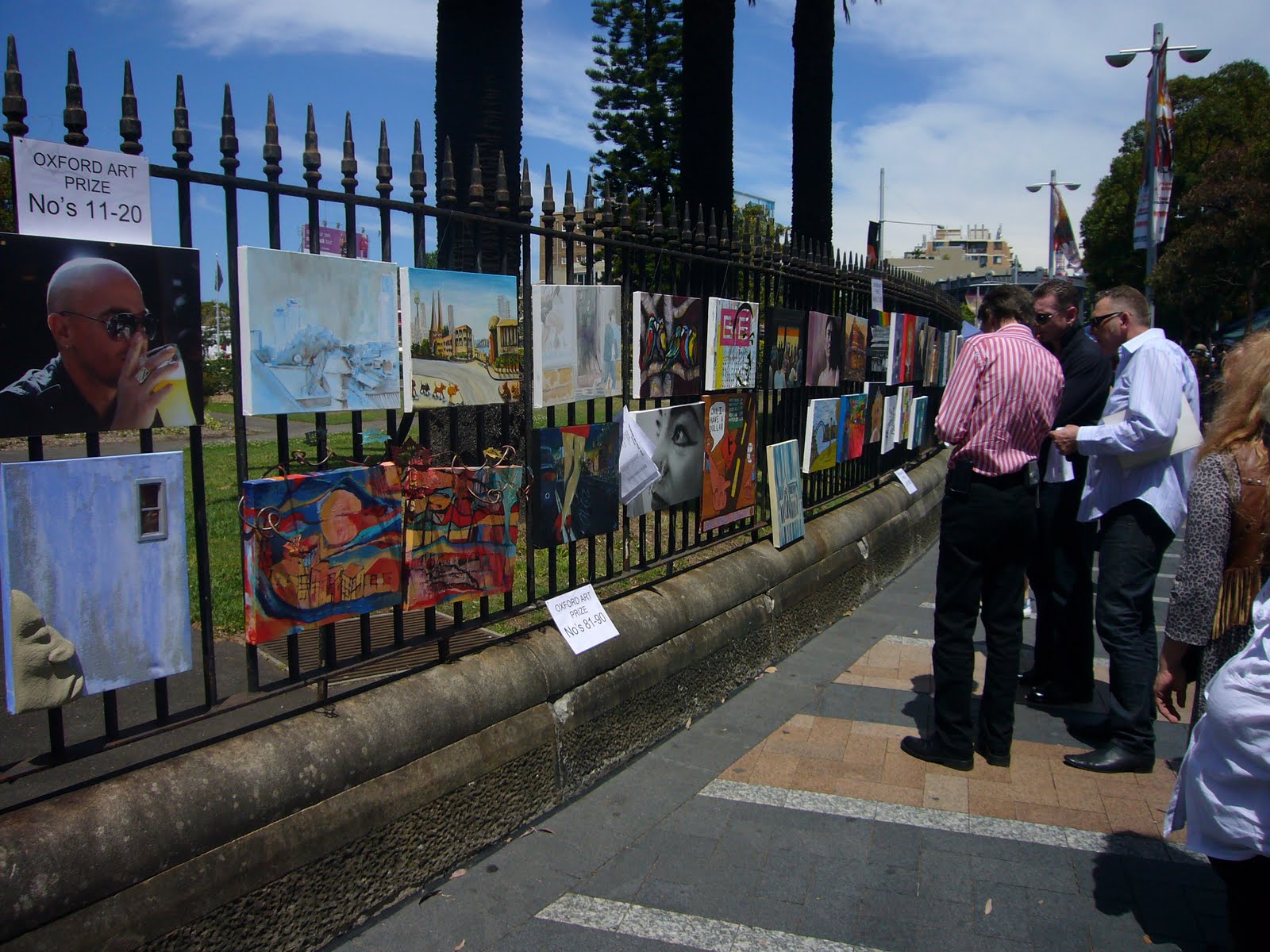
Saturday was sunny and promising so I set out with my friend, Crystal Kaye, to explore the neighbourhood and it wasn't long before we made a discovery: dozens of colourful canvases strung along the fence poles of the Darlinghurst Court House.
The six-hour Oxford Art Prize exhibition, made up of 100-plus works, was part of the Oxford Arts Festival, which runs until October 30.
The inaugural 12-day festival was designed to promote the arts, artists, restaurants and retailers of Oxford Street and Darlinghurst, which is surprising seeing as I had never heard of it.
The festival's online home is this blog that has posted just two stories since April, and has only one follower - even less than My Darling Darlinghurst.
I love a festival, especially if it's local, but it's a shame when they fail on the publicity front and don't attract the punters.
There were even mimes and other performers, including this wonderful band, to entertain the potential crowd:

The outdoor exhibition also coincided with the Sydney Sustainable Markets, which are held every Saturday at Taylor Square, so apart from art, there was lots to look at:

Compact Vegie Garden On Show

Himalayan Orchids For Sale

I'll be writing a more comprehensive account of the markets on a later visit, because on this day Crystal and I were having a fine time judging the art. The Oxford Art Prize also allows the public to vote for their favourite work. We didn't plan on it, but Crystal and I ended up voting for the same painting:

Inside and Outside in Darlo, by David Wilson

Crystal thought Wilson was the most talented artist on show. I liked his absurd characterisations and the painting's sense of debauchery. Wilson's style also reminds me of the work of veteran newspaper cartoonist and illustrator Bruce Petty.
Meanwhile, the three real judges - Dean of COFA Ian Howard, the National Art School's Stephen Little and art dealer David Rex-Livingston - were busy scratching their chins as they tried to pick a winner:

Crystal and I asked the man manning the desk when they were going to announce the winner, because we had other adventures to carry-out. But he was a bit vague and only said it would be announced between now and 4pm. Which was about two hours away.
So we wandered off and came back an hour later, asked around and learnt that the winner of the People's Prize was this striking photograph on canvas:

Augenblick, by Mandy Schone

We never learnt who won the Oxford Art Prize and the festival blog so far hasn't announced the winner either.

Tuesday, October 19, 2010

Darlinghurst: Food: Forbes and Burton

After a week of cold weather and a few days of gales, Spring finally stuck its head out from under a rug of clouds to make Sunday a fabulous day to head outdoors again. I spent the morning running errands and by 2pm I still hadn't eaten a scrap, so when Ruby Molteno called and suggested a late lunch, I swung by, scooped her up and we landed promptly at the doorway of Forbes and Burton cafe.
On such a lovely day we were surprised at first to discover an available outdoor table, so we donned hats and sat in the sun . . . until we became so sickeningly hot from its rays, and realised why most diners were sitting inside.
We placed our order and moved inside too:

Forbes and Burton is located in an 1850s building that stretches all the way from 238-252 Forbes Street, and is listed on the Register of the National Estate. I'll be doing a post soon about the history of the building, known as the Belgrave Terrace.
But I still can't talk about its 21st Century life without mentioning the building's historical sandstone walls with their chip marks from the workers' picks. The building is right across the road from the National Art School and former Darlinghurst Gaol, which is mainly built from sandstone that was dug out from the local area by convict workers.
The gaol was constructed between 1821 to 1841 and I wonder if the sandstone used on the Belgrave Terrace was hacked out by its convict neighbours or was left-overs.
The interior design of Forbes and Burton makes the most of the building's heritage aspects, but also includes nice modern embellishments, such as this crimson-pink, reflective panel:

The building was home to the very trendy Dov cafe until 2006 when David Pegrum, a former head chef at the internationally acclaimed Sydney restaurant Tetsuyas, took over the kitchen.
I ordered the special of the day, which the waiter incorrectly recited to me, and which turned out to be Braised Chicory and Salmon Fillet en Papillote with Asparagus ($22). The waiter wasn't far off the mark though (he thought the chicory was witlof) and he was right when he said it was a good-looking dish:

It tasted great too and there was some wilted greens, drenched in deliciously fattening butter, hidden beneath the fish. Ms Molteno, the all-day breakfast queen, ordered poached eggs with whole-grain toast, bacon and tomato:

I asked Ruby why on earth she always orders bacon and eggs when she could easily cook them at home. She said it's because she doesn't like to have bacon in the fridge as she wants to keep fatty temptations right out of sight. I suspect the real reason is because she doesn't much like cooking. Ruby then went on a discourse about how such a seemingly simple dish can be cooked so many ways and how each cafe's bacon and eggs tasted completely different.
Ruby said she didn't truly realise this until she went to London many years ago and discovered to her horror that some cafes didn't know how to cook bacon and eggs. As for the Forbes and Burton version, Ruby was full of admiration: the eggs were plump and free range, the tomatoes were Roma and the bacon wasn't too salty.
Then because I hadn't eaten all day and because I had to work in the evening and life is too short to say no to anything, I ordered the Chocolate Brownie with Raspberry Coulis and Yoghurt:

We weren't quite sure about the yoghurt blob - surely it should have been double cream - but the sourish yoghurt and raspberry were a good foil for the sweet chocolate.
*
Forbes and Burton
252 Forbes Street
Darlinghurst NSW 2010
02 9356 8788

Saturday, September 11, 2010

Darlinghurst: My Story


I first moved to Darlinghurst in 2002. I had been living in share-houses in East Redfern and Surry Hills but so desperately wanted a place of my own. The reason for selecting Darlinghurst was because it had, and still has, so many more studio apartments than Surry Hills or Redfern, which have mostly terrace houses and one- and two-bedroom apartments.
I only looked at one studio apartment in Darlinghurst and I was smitten. It was at 7/40 Hardie Street, next door to Flash Auto Repairs - run by the charming Peter - and just a skip away from the Darlo Bar, Green Park Hotel and the 311 bus stop.
The picture above is one of the few photographs I have of apartment number seven and was taken on a special day (face flowered for privacy) and here is a photograph of 40 Hardie Street (to the left) that I took the other day:


The rent for apartment number seven was $170 a week and $5 less than I was paying in the share-house. It was small but I didn't know any better. The kitchen was an afterthought, the bathroom had a sliding-door and the windows looked out to brick-walls and a light-well, but I loved it because it was my own.
The 12-room apartment building sold for $1.56 million two years after I moved in and was purchased by three young, and very clever, men (Arthur, Lans and Sava). They were good landlords and never put the rent up. One of them even kindly came to remove a huntsman spider that had made itself a home in the corner of the room above my bed.
I lived at number seven for five glorious years, hosting cosy (squashy) dinner parties for six, befriending the local cats and falling in love with the neighbourhood.
But my book and dress collection was steadily growing and it was clear I needed more space, so when the apartment next door - number eight - became available, I asked if I could have it. The following week I carried all my possessions about 2m to the place next door.
Number eight was a dream. It had beautiful windows that looked out on to Hayden Lane and to the rear of French restaurant Sel e Poivre, so that the kitchen staff's musical Gallic accents came floating up into my home. Another positive was that the apartment also had a bathtub.
Here is a picture of number eight:


I loved that apartment to death and even had it painted a gorgeous shade of yummy, rich clotted-cream before I moved in. I also installed a paper blind in the kitchen and thick-cream, light-blocking curtains in the main room. Sadly I wasn't to stay there for very long.
After just six months of living in luxury I accepted a job far, far away and in April 2007 moved out of Darlinghurst and gave up number eight for someone else.
Here is a picture of my last day at number eight, when I had to hand over the keys:


To be honest, I was actually glad to be moving out of Darlinghurst and Sydney. I was frustrated by my job and needed to move away from the stinky city I had grown to hate. I especially loathed the excessive planting of Plane trees, which shed fine, pollen-coated hairs every Spring and cause so much grief for my poor throat and nose. I was tired of hearing about rising property prices and the fact that every time I stepped out the door, life seemed to cost me $50.
So I moved to the seaside where I had ocean views, a car-space and a verandah for only $170 a week - 1990s prices!
For the first 18 months I was fine. I returned to Darlinghurst and the surrounding suburbs regularly to see my then lover-boy and other friends and it was almost as if I had never left.
Almost. After that first honeymoon phase I began to miss my old neighbourhood. I missed walking the streets at night, the noise and the characters.
There was one particular scene of the neighbourhood that I would replay in my head. It was walking home at dusk from Taylor Square and then alongside the National Art School, towards Burton Street. There would be a sense of peace about the neighbourhood as fruit bats in their thousands flew overhead from the Royal Botanic Gardens to search for their evening feast, while the city's workers also made their way home for dinner.
The strongest, most memorable image of that walk though, is of a large gothic-looking house on the corner of Forbes and Burton Streets, which would be in silhouette against the dying day. I loved that house at that time of day. It thrilled me for some reason. I'm sure I have a photograph of it somewhere too. (I was pleased to see today that the house is still there. Although it looks like the Caritas psychiatric hospital across the road is soon to be demolished to make way for a fancy apartment block - more on that another day.)
So anyway, I missed old Darlo and badly wanted to be back in number eight, as if the whole move out of Sydney had never happened.
I set about plotting my return and in September last year began looking at Darlinghurst studios and discovered that rents had gone up by $100 a week in the 2.5 years I was gone. It was sad, but there are worse things to spend your money on.
I trawled through the rental ads on Domain.com every waking hour for weeks and it was on a Saturday morning when I finally found what I was looking for. I am very picky. It had to be a 1930s-40s build, so that I would have high ceilings and none of that porridgey stuff they started spraying on ceilings in the 60s. It also had to have light: don't want to be depressed. And polished floors. A built in wardrobe (I don't want to own another piece of furniture). And a bathtub would be dandy too.
The place on Royston Street appeared to have everything. I dashed to the real estate agency as soon as they opened up shop and put in an application, which was approved by Sunday night and on Tuesday I inspected it and the keys were in my hands.
Here is a picture of Royston Street:


It is not the greatest street in Darlinghurst. One has to hike up Oporto Hill (or Vomit Hill, as it appears on Sunday mornings) to reach it, and it is surrounded by the dastardly plane trees, but it will do for now. Secretly, I still want number eight back.
Here is a picture of the view from my sunroom across the rooftops of Paddington with St Vincent's Hospital to the right:


Here is a picture of the view from my kitchen window, down to Rushcutters Bay and over to Darling Point. I can actually see the Moran family's mansion, Swifts.


Happy, happy to be home...

UPDATE: October 2011: I am now employed by the City of Sydney and feel that I should declare my interest here in case I should ever by accused of bias.
I have just left an industry that I loved for 10 years to embark on this new adventure and I am very excited about my new position at Town Hall, especially because I will be able to pop down to the City of Sydney Archives in my lunch breaks. And hopefully this can only be a good thing for my My Darling Darlinghurst.
Opinions, thoughts and adventures will remain my own and I still make no money from this blog; it has and always will be a labour of love.