Showing posts with label Street of the Week. Show all posts

Wednesday, March 7, 2012

Darlinghurst Blog: Street of the Week: Clarksons Mill Way

People are remembered in the strangest ways. This week's Street of the Week, which is really a pedestrian laneway, is named after Thomas Clarkson, who built the first windmill on Woolloomooloo Hill, now Darlinghurst.


Clarksons Mill Way, as the laneway is named, is possibly not the best way to be remembered, lined as it is with overflowing garbage bins and dotted with the detritus of life: cigarette butts, plastic bags and a man's pair of slippers.


The laneway, between Darley Street and Darlinghurst Road, is in dire need of some beautification. 
Nevertheless, I may never have paid Clarksons Mill Way much notice if it wasn't for the research of reader, Michael Armstrong, who was inspired to find out the story behind the lane. 
Clarkson, as I learned from Michael's story, was a bit of a shyster, who somehow managed to acquire five large properties and a number of windmils.
Through Michael's research I discovered more than I have ever known about the windmills of Darlinghurst - which arrived on the landscape about two decades before the first villas.
Along the way, Michael also led me to some marvellous historical photographs (make sure you enlarge the one of Craigend).
Here is Michael's account of the roguish life of Clarkson - and his windmills.


“In about 1819 a merchant, Thomas Clarkson, had erected a windmill near what is now the intersection of Liverpool and Darley streets (above). 
"This appears to be the first windmill in Darlinghurst: a stone mill with a mechanical turning head to catch the wind. 

Pencil sketch of Clarkson's Mill, by Henrietta Bloxsome, circa 1850.

"Close by, two post mills were built, their design allowing them to be turned to face the wind. 
"A fourth mill was built by Thomas Hyndes on his allotment close to Caldwell Street. 
"The windmills were prominent features of the landscape, often depicted in colonial paintings of the town. 
"The last of the mills to be demolished, reportedly around 1873 was Hyndes' mill, built close to Thomas Mitchell's Craigend villa. 

Craigend, with Hyndes' windmill to the right, circa late 1860s. "Taken with a Sutton water-filled lens panoramic camera, probably by Victor Prout or Freeman Brothers," according to the State Library of NSW.

"Hyndes' mill stood on the highest point of the ridge and was clearly visible from Sydney. Its position is reported to have been at the top of Beare's Stairs in Caldwell Street, east of Victoria Street. 
"The mill's building materials were possibly used to construct four terraces in Caldwell Street and maybe the stairs themselves (below)." - Mark Dunn, Dictionary of Sydney.


"Thomas Clarkson was born in Kingsbury, Warwickshire, in the UK, in 1763. 
"At 31 he married a local girl, Catherine Rayson, some 11 years his junior, and over the next few years they had four children. 
"However in March 1805, Clarkson was convicted of passing a counterfeit £1 note, and sentenced to 14 years transportation. 
"In January 1806 he was sent as a convict on the Alexander, Catherine and two children also travelling on the ship. 
"In August 1806 the four of them arrived in Sydney, Catherine purchasing a house some two months later for £38 on the corner of Hunter and Elizabeth Streets. Here she established a bakery."

Corner of Elizabeth and Hunter streets, 1933. City of Sydney Archives.

"Clarkson was convicted of “embezzling tobacco” on the Alexander and sentenced to two years hard labour. 
"On his release from Castle Hill gaol in 1808, he was assigned to Catherine as her convict servant. 
"In May 1809 he was fined £2/12/- for selling short weight loaves of bread, however in December the same year the remainder of his sentence was remitted for good conduct.
"In 1810 Clarkson was granted a licence to brew and sell liquor. 
"By the following year he already had four properties, and his properties and debts grew steadily. 
"The next year he became “bondsman” for rent on the Parramatta to Windsor Turnpike. 
"In 1814 he was contracting to build houses, seemingly supplying the upper end of the market. 
"He was also supplying fresh meat to government stores (eventually as much as 6000 lbs per annum) from his farm, and later also wheat. 
"In 1817 he took out £12,000 mortgage (now equates to $17,000,000 on average wage data) on an impressive list of properties. 
"They included a stone windmill built to support his baking and brewing business."


In the image above, from the State Library of NSW - which looks east across Hyde Park - Clarkson’s stone mill can be seen in the top right part of the picture. To the right of the mill, and rather further forward is the Australian Museum. In the distance, at the paper margin, is Darlinghurst Gaol.

"Around 1819-1820 significant cracks started to appear in Clarkson's business empire. 
"In 1819 he had built a paper mill, and the following year the beautiful Eschol Park House, at a cost of £1,500 (now a restaurant and function centre, about 5km north-east of present day Campbelltown). "However, in 1820, with the other Turnpike bondsmen — in turn having died and absconded — a suit was issued against Thomas for £1,000 in unpaid tolls. 
"In 1821 Clarkson's wife, Catherine, was convicted of receiving stolen goods and sentenced to five years transportation, although it’s not clear whether she served any of the sentence. 
"Three years later, Thomas died in Hunter Street Sydney.
"The first writ to recover debts from his estate was issued two weeks later. 
"Catherine commenced a legal fight to preserve the property she purchased in 1806 from the estate's debts. However, ownership of this property, free of Clarkson's debts was not finally established until 1836, Catherine dying some three years later." 


*

POSTSCRIPT: 
“If Only”, an online life of Thomas Clarkson, by Christine Woodhead, Marlene Willcocks and Margaret Aitken can be found here.
The first two authors are stated to be direct descendants of Clarkson. 

*
SOURCES: 

Saturday, February 18, 2012

Darlinghurst Blog: Street of the Week: Tewkesbury Avenue

Most people who live in the Darlinghurst-Kings Cross area, have their favourite street in the neighbourhood. 
For some, it is Roslyn Avenue, with its little shop-houses and cafes; for others it is the leafy-canopied Surrey Street; and, for me, it is Hardie Street - more for the memories of my life there, than for any of its physical attributes. 
One reader has written to me about Tewkesbury Avenue. 

Photograph: City of Sydney Archives, 1982.

I don't know if this stumpy little street is his favourite in Darlinghurst, but he was interested enough to want to know who, or what, it was named after.
I only really know Tewkesbury Avenue as a shortcut, somewhere to look for car spaces, or as the back entrance to filmmakers Baz Luhrmann and Catherine Martin's mansion, Iona. 
Here is his investigation into the history of Tewkesbury Avenue.


"From the 1920’s to the 1970’s there were two huge warehouses occupying the site incorporating the present day residential towers called Palisades, Kirketon Mews, Kirketon Gardens, Kirketon Manor and No. 1 Tewkesbury Avenue (entrance in photograph above)," he writes.


"Prior to this, there were four to five single-storey large houses on the site, dating from the 1850’s, which formed part of the original William Long land grant of 5 acres.
"Obviously the houses deteriorated to a point that the land was more valuable for warehouse distribution and the then council allowed for such “backward” land-use change. Strange!
"So the houses were eventually torn down to make way for the warehouses."

Photograph: City of Sydney Archives, 1921 (see Clapton House/Earls Court in the top left).

"These warehouses appear on some of the 1940s black and white photos available from Archives and form the physical reason which made it possible to amalgamate a large development site in an inner-city area. By the way, the initial developer was The Hayson Group and they referred to this site as  'Pallisades'.


"You can also find out what the warehouses were originally used for:
"The main warehouse was used as the headquarters for Yellow Cabs of Australia Ltd and the other, Harden and Johnston Pty Ltd (distributor of automobiles)."


"The first building constructed was for Yellow Cabs and its entrance was simply a private driveway sandwiched between two buildings fronting Darlinghurst Road.
"The gentleman who introduced Yellow Cabs to Australia was William Pearson Tewksbury, nicknamed 'Tewks' (notice that his surname is spelled without the 'e').
"My theory is that the driveway to the business was coined Tewksbury Avenue by the staff working for Mr Tewksbury."


*
One of the large 19th century houses he mentions, was Rosebank - one of 17 gentlemen's villas from the original subdivision of Woolloomooloo Hill.
Rosebank was demolished in the 1920s and the Pallisades apartment block on Farrell Avenue was built on the site.
Do you know anything more about Tewkesbury Avenue?
What street would you like to know the history of?

Saturday, December 3, 2011

Darlinghurst Blog: Street of the Week: Palmer Lane

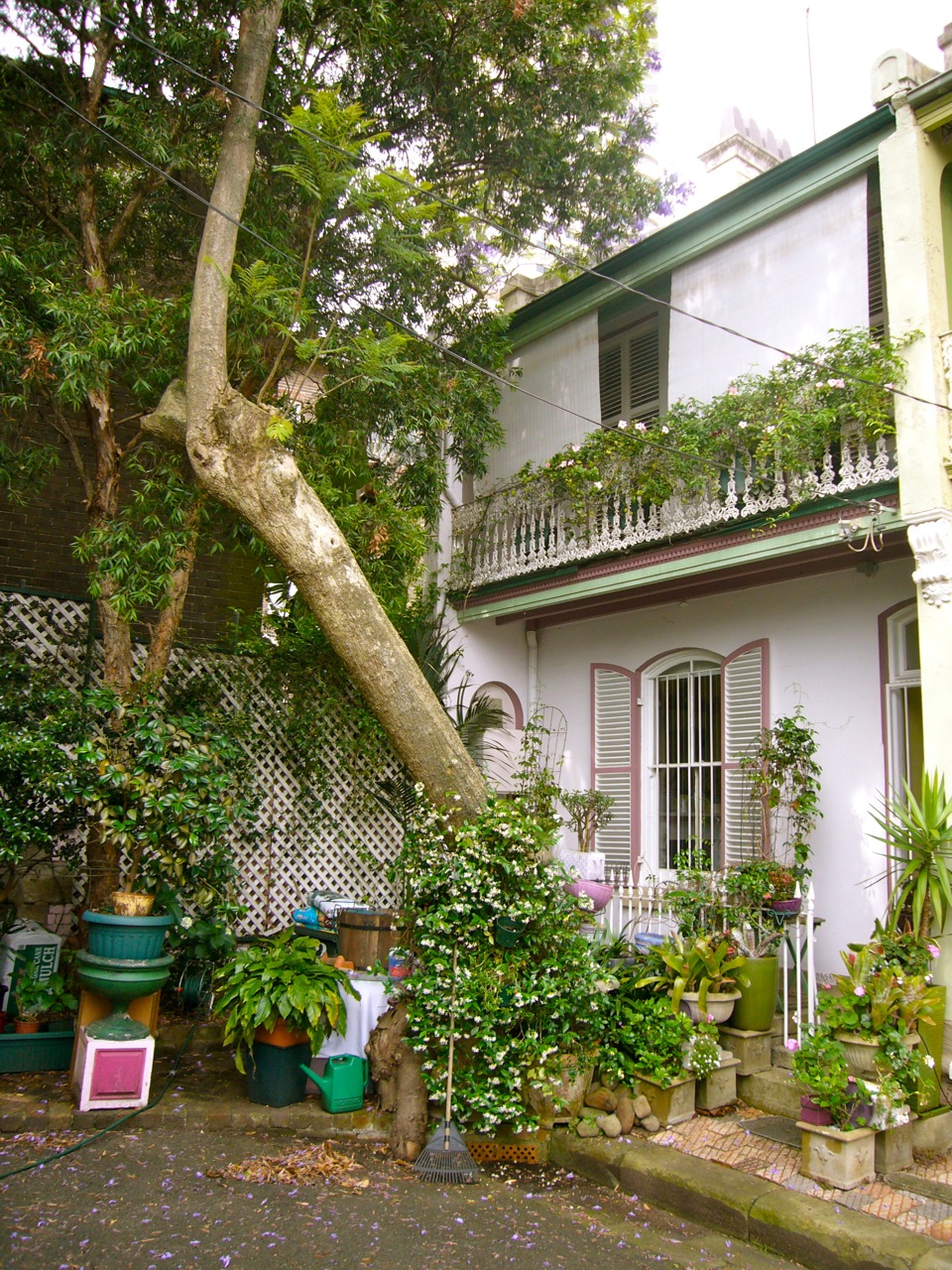
Palmer Lane must be the cutest street in Darlinghurst. I only discovered it last week while dawdling through the flatlands with my old chum, Ruby Molteno. We were walking to her apartment and she insisted we take a detour off Bourke Street, down Berwick Lane and then along Palmer Lane. And I was so glad we did. 


It was another one of those balmy Sydney days where the air was thick and warm and we felt so drunk on life as we breathed in the rich heady fragrance of flowering plants with just the softest whisper of wind falling across our faces and bare arms. 
When the weather is like that I feel like the happiest person in the world and any thoughts of blackness disappear. 
In fact I was so content I felt like lying down in the middle of the street on the hot bitumen and singing loudly.


It really was the perfect day to wander down Palmer Lane as the flowers of the purple Jacarandas, brilliant white Star Jasmine and crimson Bougainvillea had just exploded open and were at their peak.


There was also loads of interesting window boxes: the residents seem to be plant nuts. If you have 30 minutes spare this weekend, pop down to Palmer Lane for a little exploration along this very sweet street.

Friday, November 18, 2011

Darlinghurst Blog: Street of the Week: Thomson Street North

I'm starting a new occasional series today called Street of the Week. Nominate your favourite now! 
I came up with the idea after a ramble through the Darlinghurst flatlands one muggy day last week when all the colours of the neighbourhood seemed to have intensified in the heat. 


I was dawdling along Bourke Street when I noticed this vibrant Jacaranda (above left), like a violet firecracker bursting with flowers. I followed its branches up the Liverpool Street hill and along a paved area until I arrived at the northern end of Thomson Street. 
Houses ran along the east side of the street, to my right, while a fence ran down the western side protecting pedestrians from falling down a sheer sandstone-brick wall, that dropped down to a dunny lane at the back of homes on Bourke Street. The view across the city was amazing. Go and see for yourself.


And the row of houses were among the sweetest - and most enormous - I have seen. 
It seemed all the residents took great pride in their homes and street.


That neighbourhood pride was most evident right at the end of the street where one resident has set up an urban garden idyll with benches, planter boxes, hanging baskets and mirrors.


They had even built this lattice screen to create their garden enclave:


There were so many lovely things to see:


And even as I left the street and slipped up Shorter Lane to Forbes Street, there was this last lovely glimpse at the backs of homes down the gated Thomson Lane:


What's your favourite street?