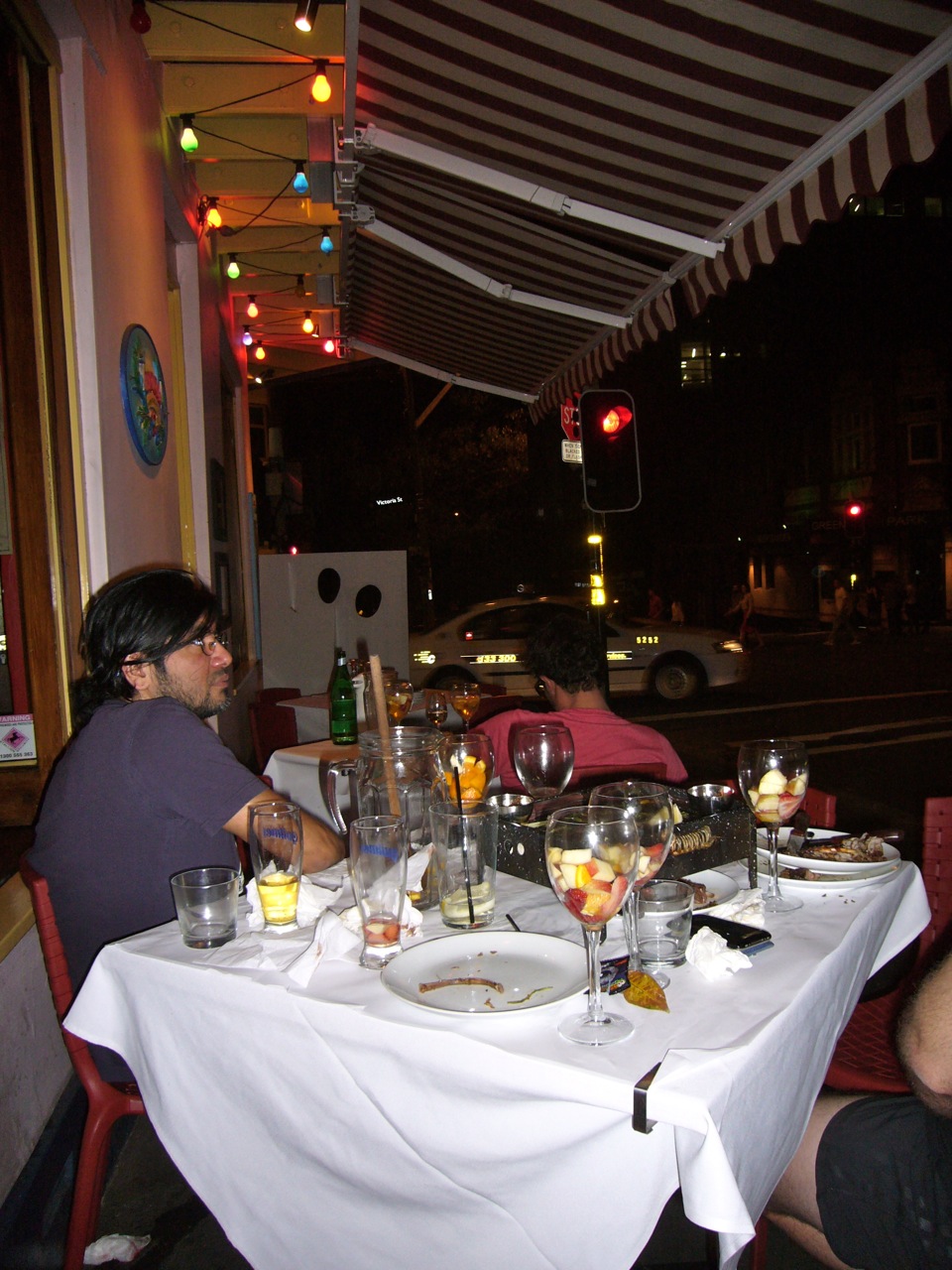
My friend Sapphire Tenzing and I always seem to eat at the same cafes and restaurants and go to the same pubs.
It's not that we are completely unadventurous. It just seems easier to meet up at the usual haunts because if we have a craving for a particular dish, we know where to find it.
Or if we are running short of cash, we know where to eat on the cheap. And it's always best to play it safe when we're broke.
That's why it's always the Darlo Bar ($12 Pad Thai for two), the Kings Cross Hotel ($12 steaks) or the Fountain Cafe (longest happy hour in the district).
But after a recent trip to the cinema to see Woody Allen's latest, Midnight in Paris, we began musing on life, dreams and romanticism and decided that we should have dinner somewhere we had never eaten before.
And that's how we ended up at Boca Argentinian Grill.
Boca opened about 18 months ago at 310 Liverpool Street, on the corner of Victoria Street, and it was hard not to notice its arrival at this bustling intersection.
The building was once home to a Pasta Pantry eat-in/take-out place and was looking a little faded.
The owners of Boca completely revamped the building, painting the exterior in a pale pink, with punchy yellow window frames and woodwork, as well as bright blue veranda railings.
Colourful lights were hung from the awnings, footpath chairs and tables were added and the building suddenly had a new, lively and more welcoming presence on the street.
From the outside, passersby could also look through the large windows into the barbecue or parilla style kitchen and see large chunks of meat hanging from hooks and all kinds of cuts being seared on the grill.
Prior to the Pasta Pantry and long before Boca, the building - which I can trace back to the 1880s - was home to another foodie joint owned by a Maltese family, the Abelas.
Joseph and Phyllis Abela lived in the upstairs of the building in the late 1940s and 50s and on the ground floor operated a corner shop delicatessen.
In March, 1950, Phyllis died at the Royal Women's Hospital in Paddington, leaving Joseph as sole carer of their six children - Deirdre, Carmen, Lena, Victor, Josie and Mary.
Two years later, in September 1952, the Abela's shop was robbed by an armed man who threatened young Deirdre with a pistol.
A man early last night held up a young Maltese girl at pistol point in her father's mixed goods shop at the corner of Liverpool Street and Victoria Road, Darlinghurst, and stole 15 Pounds from the till.
The man threatened to shoot the girl, Deirdre Abela, 17, if she screamed.
He then snatched the money, ran out to the street and apparently escaped in a car.
Miss Abela said she was alone in the shop about 8 o'clock when the man walked in.
He asked for a drink and paid for it.
''He seemed very nervous," Miss Abela said.
''He had the drink and asked for a packet of cigarettes.
"I put the cigarettes on the counter and asked him for the money.
''He pulled a grey looking pistol from his pocket and said, 'Don't you scream or I'll shoot you'.''
''I started to say, 'You . . . ' and he said 'You shut up', waving the pistol at me.
''I didn't scream because I didn't want to get shot.
''He reached over the counter, snatched two Five Pound notes and five One Pound notes and then ran out the door.
''I ran around the counter and into the street and saw a car pulling away at high speed.''
Miss Abela rang her father, Mr Joe Abela, who was visiting some relatives.
Mr Abela rang the police.
Police in wireless cars searched the area but found no trace of the man or a possible accomplice.
Miss Abela told the police the man spoke with a foreign accent and was of foreign appearance.
She said he was about 26 years, 5ft 5in tall and appeared to have one black eye.
I can find no record of whether the police ever caught the pistol-packing, thieving foreigner and I don't know what happened to the Abelas. I hope Deirdre wasn't too disturbed by the experience. She seemed fine enough to speak to the Sydney Morning Herald's crime reporter, so I imagine she wasn't too scarred. The counter where she was robbed would have been where there is a long eating bar at Boca (above).

The interior of Boca is even more colourful than the outside, with rich red walls on the ground floor, while the collection of rooms on the first floor are covered in hyper-coloured blue and yellow stripes.
There's also an excellent open air area on the first floor, which would be a great place for a work party or large group of friends, because you could take over the whole space.
A lot of care has gone into the look and feel of the restaurant and that same thoughtfulness comes across from the waitstaff too. We had about four staff waiting on our table and they were really friendly and super efficient.
Saph and I grabbed a table outside so we could watch the passing parade of people in Halloween costumes and within minutes a waiter was pouring us glasses of the house-wine from a penguin-shaped carafe, called a pinguino ($23).
The pinguino was the cutest thing we had seen all day and had us in stitches as I would never think to associate penguins with Argentina. We asked the waiter what on earth the penguin meant, but he just shrugged and laughed and had no explanation.
The only clue I could find while googling was that serving wine from penguin-shaped jugs was popular with working class Argentinians in the 1930s and that most elderly Argentinian still have them in their cupboards.
Then I also learned that the Argentinian coastline is a breeding ground for the migratory Magellanic Penguin and six other species of the water bird, including the Macaroni, Chinstrap and Rockhopper penguins.
I didn't know there was such a thing as a Macaroni Penguin either.
But now I know that the Macaroni Penguin - which has a rather extravagant yellow crest - takes its name from the 18th century British term macaroni, used to describe a flamboyant fashion style such as that worn by the character, Yankee Doodle.
"Yankee Doodle went to town, riding on a pony, stuck a feather in his cap and called it macaroni."
Anyway, there's no macaroni on the menu at Boca, just loads and loads of meat.

Saph and I skipped the entrades, such as the empanadas (two for $11), South American pastries with savoury fillings; the torta frita, an Argentinian cheese bread ($3); and the picada, a sharing plate of cured meats, pickled veal tongue and rolled flank steak stuffed with vegetables, olives and pickled yellow peppers ($23).
Instead we went straight for the parrillada pampa main meat platter (above, $60), which featured lamb leg, rump steak and chicken thigh, all marinated and sizzling away on a mini table-top barbecue with sides of chimichurri sauce and salsa criolla.
The platter came with our salad of choice, ensalada del berro, which was the tiniest bowl of watercress, spanish onions and capers in lemon dressing.
We also ordered another side, papas estralladas ($10), or crushed potatoes pan fried with garlic and olive oil, which was also rather small for the price.
We didn't mind too much though, because by then we were already on to our second pinguino and were so full that we were struggling to get through the large selection of meat on the grill. There was enough meat for four people and only enough salad for one.
When we could eat no more, the waiter vanished with our leftover meat and returned with it in two fashion boutique-style paper bags - no one would have any idea we were carrying home large quantities of meat.
You would think by now we would have been wise to call it quits, but then some sweet treats arrived on the neighbouring table and we couldn't help but be envious.
We had already spent most of the night watching the endless array of food being brought to the table of three men who seemed to know the Boca owner. The final dish they were served was a rectangular plate carrying three 1cm-thick chocolate coated circles and they looked delicious.
A waiter told us they were a traditional layered sweet pastry called alfajores, and that each Argentinian province had their own unique varieties, which come with different pastries, fillings or coatings.
The Boca plate of three alfajores, which variously include jam or caramel fillings, costs $29, or they are $12 each.
We decided against an alfajor as we had already eaten too much, but then the waiter returned with an alfajor on a plate and said it was complimentary. He was so sweet.
We chopped it into four and realised we could manage to squeeze a bit more food in after all.
It was the most amazing thing, kind of like a gourmet wagon wheel, with biscuit and caramel covered in crisp chocolate.

As we walked home we reflected on how friendly the waitstaff were, especially the young man who brought us the
alfajor. Then while we were discussing how inexpensive all that food was, we realised they hadn't charged us for the second
pinguino either.
This hospitality wasn't wasted, as both of us can't wait to return for a rooftop night with endless
pinguinos and
alfajors - and it could become one of our regular haunts.

*
Boca Argentinian Grill
310 Liverpool Street
Darlinghurst NSW 2010
02 9332 3373