Showing posts with label Bayswater Road. Show all posts

Friday, April 13, 2012

Across the Border: Kings Cross: History: Hensley Hall

You may remember, back in May last year, I invited you along on a tour of Hensley Hall, the 1912-built former private hotel and boarding house on the corner of Bayswater Road and Ward Avenue.
At the time, caretaker-resident, Barry Minhinnick, was about to be evicted after 20 years of living in the 36-room residence.


Well, almost a year later, Barry the bower bird is gone and a big padlock keeps the front door shut tight. The lettering, Hensley Hall, has been removed from the front facade.


Cyclone fencing has been put across all the window to keep out unwanted guests.


And the entire building has a horrible locked-up, dormant feeling. 
All life has left Hensley Hall. 
It is a building in neglect.
And where is Barry? He says he is happily settled in another inner-city suburb, but I have the impression that after a generation of living in Kings Cross, he misses the old neighbourhood dearly, despite his apparent optimism for his new home. 
And I also think his old neighbourhood, and Hensley Hall, too, miss him  - and need him.


Since Barry left Hensley Hall, the building has been in steep decline.
 Squatters moved in for about three months, using a garbage bin as a ladder to climb over this fence out the back. The police were called and the trio were kicked out about three weeks ago.


But the saddest aspect of the building's decline is the vandalism of Barry's "Simple Garden", which was once a curious paradise of found objects and plants that was bursting with joy and life.


The fence palings have been kicked in, rubbish litters the garden and thieves have taken anything of value, proving that dormant or neglected buildings become easy targets for vandals and their pointless destruction. 
I heard along the grapevine - and I don't know how accurate this is - that the owner has accepted a $100,000 deposit on Hensley Hall, conditional on the building being given development approval from the City of Sydney. 
Apparently, a development application for a 24-room apartment building on the site was approved in 2007. The new would-be owner wants to push that to 54-rooms. 
Apparently the original DA was approved on the condition that the facade of the building, which is an important historic feature of Bayswater Road, be kept if the development proceeds.
But as I said, I have no idea of the truth of any of this, and it's possibly just gossip.


In the meantime, and for the future, I would hope that someone steps in - the City of Sydney, perhaps - to ensure that Barry's garden is maintained now, and also kept in place if the development proceeds. 
The garden is not just part of Barry's legacy or a lesson in reuse and recycling, but it is part of the heritage of the site and a reminder of the life and lives that came before. 


I hope it doesn't disappear from neglect and ambivalence.

Sunday, March 4, 2012

Darlinghurst Blog: Villas of Darlinghurst: Kellett House


Kellett House (detail), artist unknown, circa 1876.
Built on an allotment of over 3-acres granted to Samuel Augustus Perry in 1831.

The first NSW Premier, Stuart Alexander Donaldson, was one of Darlinghurst's first residents and can lay claim to the naming of Kellett Street. 
In the mid-1800s Donaldson moved into a large, two-storey villa on a 3-acre plot, where the Hotel Mansions on Kellett Street and Baywater Road sits today.
The villa, originally called Bona Vista, had been built for Samuel Augustus Perry in 1831, and Donaldson renamed it Kellett House, giving the street its name.


Perry was granted the allotment by Governor Ralph Darling, but unlike most of the gentry who were given the original 17 plots on the ridge of Woolloomooloo Hill - which came to be known as Darlinghurst - he had a rather scruffy appearance.
The London-born soldier and surveyor, who arrived in Australia with his wife and six children in 1829,  sat for his portrait in the 1800s and the unknown artist captured a man who looks more like the hipsters that roam around Darlinghurst today.


His hair looks like it could do with a good brush, his sideburns are very 2005 and his unbuttoned, military coat looks straight off the Autumn-Winter 2012 runway. A man ahead of his time, perhaps.
Perry came to Sydney to serve as the deputy to NSW Surveyor General Thomas Mitchell, and he clashed with the older man who was jealous of anyone he thought likely to succeed him.
Therefore, Perry was generally assigned mundane duties so Mitchell could accuse his underling of being idle.
Perry didn't live in Bona Vista for long and in 1834 sold it at auction to Richard "China" Jones MP, who renamed the villa Darlinghurst House, after his wife's good friend, Lady Elizabeth Darling, wife of the Guv.
While researching this transaction, I came across this gem of an article from the 30 November 1937 edition of The Sydney Morning Herald, written by Joseph Reidle:


"Ghosts in Crinolines, When Kings Cross was dotted with stately homes.
"A great effort is required to imagine that King's Cross (sic) - the present throbbing centre of Sydney's night life - was once sparsely dotted with stately homes, where demure ladies drove leisurely through private avenues of trees in their carriages.
"Those were the days when land was owned by the acre. 
"To-day (sic), despite stout resistance to the demolisher's picks, century-old homes are being knocked down so that the task of converting King's Cross into a swarming, human ant-hill may proceed uninhibited.
"Roslyn Hall and Orwell House are already man-made ruins, and a similar fate awaits Kellett House, Springfield and Larbert Lodge. 
"But before modern mammoth structures completely annihilate even the memory of their long lives, these last survivors of a bygone age merit at least a brief obituary."

The article goes on to describe, in words and pictures, the ruin-like state of some of the original villas and, despite the fact that the Villas book states Kellett House was demolished in 1877, it appears from this article parts of the home were still around in the 1930s.


So, after Donaldson moved out of Kellett House in the mid-1800s, it was purchased by wealthy squatter W.F. Buchanan.
The original plot was subdivided from 1864 and Buchanan demolished part of Kellett House and built a terrace on the site, known as Bayswater Terrace - obviously how the road today was given its name.
The Hotel Mansions was built in the late 1800s and remodelled in 1918. 
The remains of Kellett House were sold in October 1937 and it was probably demolished soon after.
Today, the Hotel Mansions is about to be converted into designer apartments known as Manor, and the area continues to be a swarming, human ant-hill.


*

Tuesday, January 24, 2012

Darlinghurst Blog: Villas of Darlinghurst: Goderich Lodge

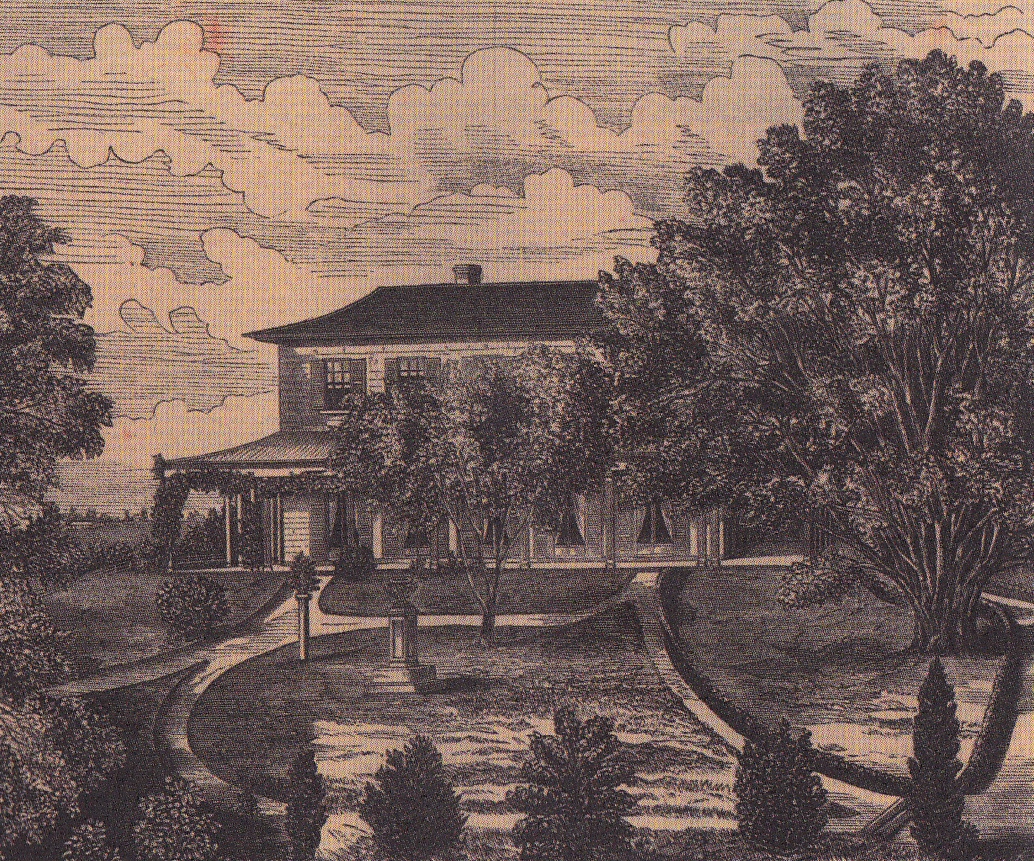
Goodrich (sic), The Residence of Captain Smith, artist unknown, 1875 (detail).
Goderich Lodge: allotment of over four-acres granted to Thomas Maquoid in 1831.

This Darlinghurst mansion-house, or villa, was designed by John Verge for the High Sheriff of NSW, Thomas Macquoid, and was situated near what is now the corner of Bayswater Road and Penny Lane. 
Born in Ireland, Macquoid came to Australia in 1829, following a period in Java, where he produced coffee crops for the East India Company, as well as a tenure as Sheriff of India.
The 1832 mansion house was named Goderich Lodge, after Lord Goderich (Frederick John Robinson), the then Secretary of State for the colonies, who was also the British Prime Minister for a brief period. 
Macquoid arrived in Australia full of optimism for his new role in a new colony, but very soon had slunk into depression.
His first major issue was with his new job, which he believed did not have the appropriate status for such an important position. His office was also understaffed and overwhelmed with work. Litigation and bankruptcy proceedings were rife and there were over 700 summonses to be served.
To worsen things, Macquoid was also suffering financially after investing in a large farming property in the Tuggeranong Valley, near Canberra, which he named Waniassa. The country had been hit by drought, while the colony was also in financial collapse. 
Unable to cope, Macquoid committed suicide in October, 1841, leaving his son Thomas Hyam to deal with his mounting debts.
(Incidentally, Thomas Hyam was one of 121 people who died aboard the wreck of the clipper, Dunbar, which crashed into rocks at South Head, at the base of suicide-spot, The Gap, in 1857; his body was never recovered. The Dunbar's anchor was retrieved and is mounted at The Gap as a memorial.)


Goderich Lodge was sold at auction two months after Macquoid's death and in the years that followed was rented by the First Bishop of Australia, Dr William Grant Broughton, whose wife died at the house in 1849. 
The next tenant was Surveyor General Samuel Augustus Perry, and then in the 1850s, Goderich Lodge was purchased by Frederick Tooth, of Tooth's Brewery fame, who later sold it to shipping merchant Captain Charles Smith (which was when the illustration at the top of this post was created).
Captain Smith died at Goderich from embolism in June 1897 and his wife Marjorie stayed on at the home until at least 1904 when her daughter, Marjorie, married.
By then, the original four-acre land grant had been subdivided and there were a number of properties on Macquoid's original estate. 


According to the book, Villas of Darlinghurst, Goderich Lodge, demolished in 1915, was located where the old Hampton Court Hotel sits today (above).
The name of the old British PM still remains however, in the laneway that runs along the back of the old Hampton Court Hotel, Goderich Lane.
The Hampton Court Hotel, which has been pretty much dormant since the late 1990s has finally been refurbished into apartments, know as The Hampton.
And before you start complaining that all the old hotels in the area are being converted into apartments, the hotel actually began life as a 100-flat, apartment block, Hampton Court, after 1915. It was converted into a hotel in the late 1930s, following the death of its owner, motoring industry pioneer Albert Gordon Hampton.


This City of Sydney Archives photograph (above) was taken in 1910 from Bayswater Road, looking down Penny Lane before Hampton Court was built.
The Victorian-era terrace house to the left would have been built up alongside Goderich Lodge as the land was subdivided. Shame there are no photographs of the lodge, which was obviously further back somewhere.


Just over 100 years later, there are no signs of the old Darlinghurst at this corner.


The only distinct trace, apart from the laneway, is the curve of the gutter.


From the rear, looking down Goderich Lane, the Hampton Court is massive. 


And I wonder if the trees at the right in this archive photograph are the ones that surrounded Goderich Lodge, which feature in the two illustrations. 

*

Monday, July 4, 2011

Across the Border: Rushcutters Bay: People: Lester Sinclair

I received an email recently from Canberra-based writer Chris Vening who is writing a biography about Australian author Lester Sinclair (above), who wrote and published children's books during the war years under the pen-name John Mystery. Sinclair was born in the UK in 1894 and migrated to Australia from New Zealand, where he had joined a circus.
Sinclair wrote about 300 John Mystery books and they were massively successful. According to historian Derrick Moors, between 1944 and 1946 Woolworths supermarket chain signed a contract with Mystery's publisher, Publicity Press, for 9.5 million copies of around 230 different titles. 


Many of the books were printed on poor quality and yellow paper because that was all that was available during the war. Moors notes that in My Little Sailor's Book, Mystery wrote a note to his readers apologising for the shortage of books and reminding them that, ''the fighting services must of course, come first in everything and, therefore, paper for my books is not so easy to obtain as in normal times . . . the government has been good to us, and everyone is doing everything possible to give you books.''


Moors also says one of the ''enduring'' aspects of the books is Mystery's Dear Cobber letters, in which he encouraged his young readers to write to him at Adventure Castle, Sydney:


Sinclair built the folly, Adventure Castle, at Illawong on the Georges River in Sydney's southern suburbs and lived there with his wife, Ellen Sinclair, who was a cook book author and food writer with The Women's Weekly in the 1960s, 70s and 80s. Unfortunately the castle has since been demolished and replaced by units, although some of Sinclair's commissioned animal carvings, by artist Ilja Chapman, still survive in the sandstone cliffs of the property. 
Before Sinclair moved to the castle, he lived at The Alexander apartment building on Bayswater Road in Rushcutters Bay. And that is why Vening wrote to me. 


According to Vening, Sinclair lived at 11/67 Bayswater Road between about 1938 and 1942 and this was the period when he met Ellen. I'm afraid I was not much help to Vening as I could find absolutely nothing about the Alexander building in the usual archives that I trawl. 


But I did refer him to Trove and other online archives and he was able to find a reference to The Alexander from 1919, when it was apparently 35 Bayswater Road, not number 67. I actually think the building looks like it's from a later period, say late 1920s, early 30s, but I am no expert on architecture. 


I was going to buzz number 11 and see if I could convince the resident to let me have a look for Vening's sake, but then I really don't want to enhance my reputation as a local weirdo any further.
Anyway, if you know anything about The Alexander, its history and residents, specifically in the period when Sinclair lived there; or if you have any old photographs of the building, please contact Vening: vening@netspeed.com.au
Sinclair died on October 5, 1974. I can't wait to read Vening's book, as Sinclair's life sounds quite colourful. 

*
Sinclair Picture Source: State Library of Victoria
Adventure Castle Picture Source: Sutherland Shire Council Library

Monday, May 30, 2011

Across the Border: Kings Cross Blog: Hensley Hall

My dear friend John Webber was telling me last week that Barry Minhinnick, who has been the caretaker-resident at Hensley Hall since 1992, was about to be evicted. If you live in the area, you would  know Hensley Hall, a grand old former private hotel at 35-39 Bayswater Road. You would probably also recognise Barry from either seeing him sitting on the front-steps of Hensley Hall playing guitar, or just around the streets of the Cross on his latest bicycle. 
I was quite bewildered about the news of Barry's potential eviction, so John and I rushed over to Hensley Hall to see if he was home. We cased the joint from the back alley . . .


. . . and around the side past Barry's ''Simple Garden'', which he has been developing over the past ten years from objects salvaged from construction sites and dumpsters:


It's a really creative garden with sculptures and garden beds made from old spring-beds, hot-plates, ovens, fence palings and other found objects.


The garden was the subject of a Gardening Australia television segment last month called, A Kings Cross Treasure.


It has also inspired the imaginations of many people who walk by.


When John and I came around to the front of Hensley Hall, there were piles of books on the front steps and along the footpath that Barry was giving away for free.


Luckily, while having a snoop through the books, Barry spotted us, stuck his head out the window and called out: ''News gets around fast.'' He was referring to the eviction and then invited us inside to explain. I can't go into the details of the eviction as it is subject to court proceedings, but I can take you along on a tour of Hensley Hall.


Barry is in packing up mode, so there were piles and piles of books everywhere. He is also a bower bird, so the place is full of curios, both historical and just plain interesting.


We sat in Barry's kitchen while he filled us in on the history of Hensley Hall and showed us some of his collection.


Barry moved into the residence in 1992, shortly after it closed down as a boarding house.


While packing up his belongings he came across this old copy of The Sydney Morning Herald from 1989. He had kept it because it was about the fire in the Down Under Hostel, on Darlinghurst Road, in which six backpackers lost their lives. 


According to the headlines, Abe Saffron owned the building, which was just next to McDonalds on the strip.


Barry has also collected a dead rat (which I nearly trod on):


Some oil paintings salvaged from the Hampton Court Hotel on Bayswater Road, which is currently being converted into apartments:


Electrical boards:


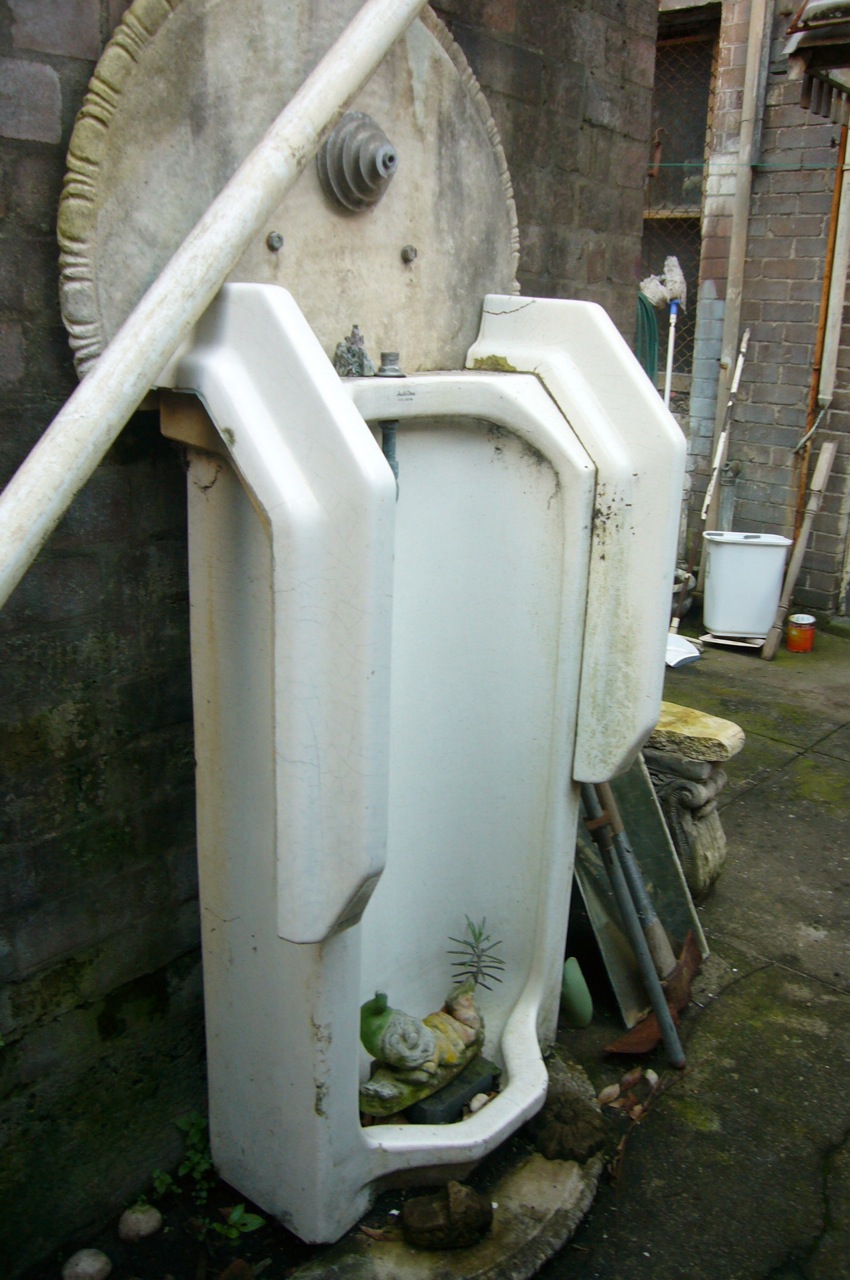
And latrines:


Anyway, as Barry was telling us, Hensley Hall was built in 1912, designed by architect Barry Greig, and the present owner purchased it in 1938.


The last person to live in the building before Barry was a Rat of Tobruk called Ernie Joyce. Joyce was among dozens of tenants in the then boarding house in the 1980s, but during that decade the owner evicted everyone, save for Ernie and about four other diggers. 


As the diggers dropped off, Ernie remained and was kept company by his friend, Austin Roonan. But when Austin died inside Hensley Hall, Ernie became too frightened to live on his own, so he moved out and Barry moved in to keep the squatters away.


There are 36 rooms in Hensley Hall, which are located across two wings and a double storey building in the back yard. 


I must admit that I rather lost my bearings while being led through the rabbit warren of rooms.


The building is presently owned by Hensley Hall Pty Ltd, a company directed by John Chapman and Stephen Williams, who are based in the suburbs south of Sydney.


I imagine that if they choose to sell Hensley Hall, they could make millions, based on its location. But the building would have to be demolished as there are vast sections that are just rotting away from the rain. Barry mainly lives in the front section of the building, which is less damaged, and he even demonstrated the ''bucket of water out the window'' method that he has to employ when it rains.


It's a sad end to a once grand building, which was initially known as Mercedes.


The first mention of the building in The Sydney Morning Herald was in September 1921 when Harold Julian Wilberforce of 52 Bayswater Road, sued Marie Boeck, the boarding-house keeper of Mercedes for the recovery of 75 Pounds in damages (the value of a suitcase, jewellery and personal effects) as well as 10 Pounds for alleged detention. 
Mr Wilberforce had been a boarder at Mercedes and when he enlisted in the AI Forces in February 1918, he arranged for two suitcases of his belongings to be stored at the boarding house while he was away at camp. But when he returned from war only one suitcase could be found. 
Ms Boeck claimed that Mr Wilberforce had actually taken one of the suitcases with him before he went to war. Judge Curlewis of the NSW District Court found in Ms Boeck's favour. 


On Tuesday November 13 1934, there appeared in the Social and Personal column of the Herald, this short mention:
''Mrs David Aitken has returned from Moree. She is staying at Mercedes, Bayswater Road, until her own flat at Darling Point, which she let while she was away, is vacant.''

On April Fools Day, 1935, an advertisement was placed in the Herald:
''Watch - Lost Gold Elgin Watch and Gold Fob in Bayswater Road between Alexander Flats and Mercedes Private Hotel at 1pm Sunday. Person who picked up phone FL2343 or return to Mercedes, 39 Bayswater Road, Darlinghurst. Reward.''


In 1936, the owner of Mercedes, Neville Mayman, began placing advertisements in the accommodation pages of the Herald:
Established a quarter of a century.
For better food, better service, and better and cleaner accommodation.
Very moderate breakfast and terms for permanent or casual guests. 
Unfailing hot water, laundry facilities free.
Inquiry and inspection invited.
Neville Mayman, proprietor, Tele FL2343.


Three years later, in 1939, the building was mentioned in the ''From Day to Day in Sydney'' column in the Herald, when Mrs L. M. Bloom hosted a fundraiser at her Bayswater Road home, Mercedes. About 150 people attended to raise money for the Lord Mayor's Bushfire Relief Appeal. 

The building's name must have changed from Mercedes to Hensley Hall in the 1940s, for in January 1942 among the many To Let listings in the Herald there was:

''Kings Cross, Hensley Hall, 37 Bayswater Road - Attractive, furnished flats, community bathrooms, kitchenettes, accommodate one and two persons, rentals include clean linen, daily cleaning, electric light. Low rents. T Elliott and Co, FL 2721, Kings Cross.''

Similar advertisements continued to appear into the 1950s. 


Razor author Larry Writer was born in Sydney in 1950. At the age of seven his parents split up and Writer and his mother went and stayed at her sisters's place at Hensley Hall. 
''We stayed there six to eight months and I went to Darlinghurst Primary for a while,'' Writer told the Sun Herald's Matt Condon in 2001.
''I remember people sitting around in their singlets and braces watching the horse racing on television.''
I imagine Hensley Hall stayed in much the same state right up until the early 1990s when Barry moved in. But without much investment in keeping the building upright, it is really starting to crumble. 


After looking through the front wing, we headed out the back where there is a two-storey building. We climbed up a spiral staircase in the building to a kind of loft apartment, which opened on to a large outdoor area.


The outdoor area looks down to Roslyn Street and would be a great place for a party.


From the rooftop, Barry took us back downstairs and outside to an entrance to the second wing, which is really falling to bits and quite dangerous to be in or near:


We had to walk really carefully over the floor, which had pretty much rotted away and was covered with old roof sheeting. We also had to be careful not to stomp around or make too much noise as the vibration could have caused the ceiling to fall off. It was dangerous but Barry really wanted to show us this amazing stairwell:


Back in John's rock photography days he apparently paid Barry $100 to use the stairs as a set for a photograph of Australian hard-rock band, The Screaming Jets. In those days - say mid 90s - the stairs were still in good condition, but look at them now. John has promised to dig out that Screaming Jets photo, so that I can see what the stairwell once looked like (when he does, I'll add it to this post). Now though, I don't think the stairs would even be safe to walk on and the ceiling also looks like it could collapse at any minute:


Still, I'm not averse to a bit of a ruin and I find it quite remarkable that this dilapidated 99-year-old building still exists in the busy heart of Kings Cross in 2011. After John and I farewelled Barry and wished him luck, we stopped again to look at the free books on the front step and noticed this little piece of Minhinnick wisdom:


''Who knows, maybe along our journey through life we may pause and contemplate the beauty of learning, in so doing building a positive world. Happy reading.''