Showing posts with label Royston Street. Show all posts

Thursday, May 16, 2013

Darlinghurst Blog: Animal Life: Ralf the Cat


I've been a bit quiet on the blogging front recently and that's mainly because I've been feeling a bit blurgh. I've wasted far too much time watching television series on my laptop and being generally unproductive and uninspired. Adding to this general malaise is the fact that my muse appears to have left the neighbourhood.


I first met Ralf the cat in 2010 when I moved back to Darlinghurst and set up house in Royston Street. I didn't know his name for a long time, but would often stop with him to pat and chat.


It seemed that every time I went outside, Ralf was hanging about somewhere, a regular presence in the street.


You didn't have to search hard to find him: just look for the sunniest, warmest spot in the street and Ralf would be there. 


During the day Ralf would sleep in whatever sunny pocket he could find, whether it was on a car, in a garden bed or even in the middle of the road. 


But cars were a particular favourite, especially when the motor was still warm. 
I once watched as a driver returned to their car to find Ralf asleep on the bonnet. The driver sat behind the wheel and started the engine, but Ralf didn't move. He simply woke slowly from his slumber, looked at the driver and sat there staring.


One time I saw Ralf taunting Digger the dog on Craigend Street. (Digger was also a regular street character, but moved out of the area earlier this year after nipping one of the children in his house.)
Digger was madly barking behind his fence at the cheeky cat who would dare come near his home. Ralf strolled by, barely giving the dog a glance. 


I admired this about Ralf, his carefree, fearless, don't give a damn attitude and often wished I could be the same.
If Ralf was crossing the road and a car came along, he wouldn't run to get out of the way, but just continue sauntering on with his tail in the air.
If you stopped and gave him pats and he purred and you thought that you had won him over for life, he would then completely ignore you the next day.
He just had that way about him. And because he was so difficult to win over, it made me even more determined to be his friend.


So no matter where I was going, or even if I was running late, I always made sure to stop and say hello to Ralf, give him a rub under his neck and pat the dust and malting fur off his back. 


During these days of wooing him, I often wondered where Ralf lived. 
Once I had seen him jump out the ground floor bathroom window of a neighbouring apartment block. Another time, I saw him go into the building of the man with the umbrella, who lives in my street. 
Other times I spotted Ralf loitering around on Craigend Street and as far away as the little park on Nimrod Street. So he may not have lived in Royston Street at all.


Ralf soon became familiar with my attentions and the way I would call out, 'Ralf!' in a sort of loud, breathy whisper when I saw him. And it seemed his attitude towards me started to soften.


One night, while coming home late, I saw him sitting on the bonnet of a large 4WD and just by habit called out his name: 'Ralf!'
Ralf leapt off the car and ran towards me where he was greeted by his usual pats. 
Then as I said goodbye and walked towards my home, he followed me, right inside the door, up the stairs and into my apartment.


He soon became a regular guest.


I'd see him on the street, call out 'Ralf!' and he'd trot along with me to my door.
Once I called out 'Ralf!' and he followed me all the way across Craigend Street and down to Ward Avenue, about 500m away.


In my apartment, I would place a dish on the kitchen floor and feed him cheese and ham and milk and whatever I could find of interest to him in the fridge. 
I eventually started buying little packets of Dine cat food from the supermarket and always made sure I had ample supply in case Ralf should visit.


He was rather picky about what he ate and would occasionally refuse to eat the new Dine flavour I had bought him, such as Turkey in a Delicious Gravy or Country Chicken. 
When that happened he would just sit in the kitchen expecting me to dish something else up.
I refused to pander to this behaviour and would just ignore him. 
But it didn't happen often, as Ralf mostly had a ferocious appetite - which only added to the mystery of his living arrangements. 
Did anyone feed him regularly? Where did he go when he wasn't in the street? 
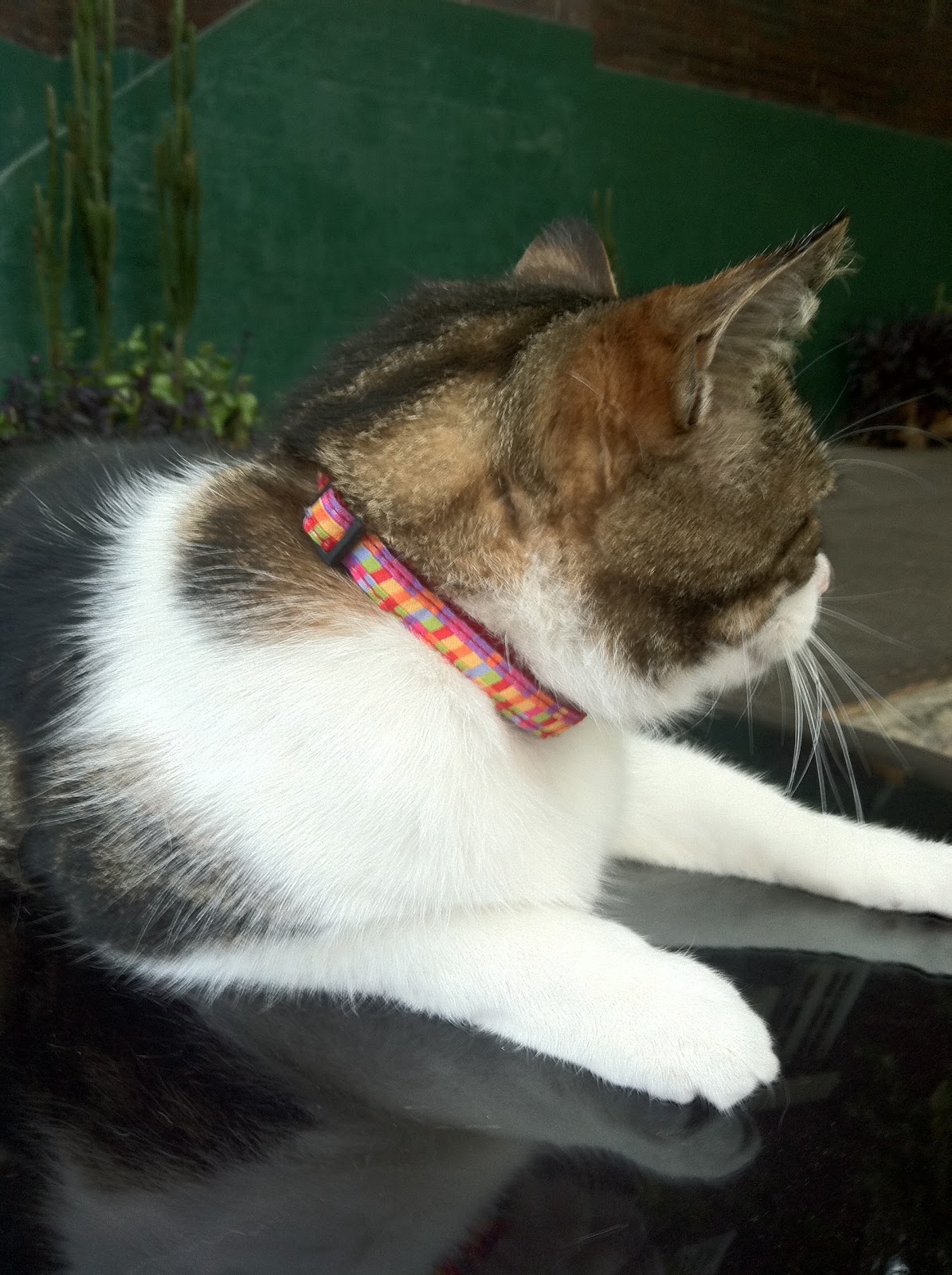
Yet despite his apparent independence, he was always wearing a different new fashionable collar, strung with a metal circle engraved with his name. So clearly he had a home somewhere.
Once he had eaten his fill, Ralf would stand by my front door, waiting to be let back out into the street.
At first, the visits didn't last long.


But soon, Ralf began to make himself at home. 
Instead of standing at the front door when he finished eating, he would stay awhile and keep me company.
I'll never forget the day when I was lying on my bed reading and he climbed onto my back, padded around to make himself comfortable and then fell asleep.
It was a rather uncomfortable 10 minutes, but his presence was still a comfort to me nonetheless.


One day I saw the man with an umbrella talking to Ralf, so I went up and asked him if he was his owner. 
The man said "No, Ralf just comes up to eat sometimes. He visits a few different people in the street." 
"I think he lives in that apartment over there," the man said, waving to the place where I'd seen Ralf emerge from the bathroom window. 
So Ralf really did have a home. And I wasn't his only friend.


Still, I liked to think that Ralf preferred me best, especially when I returned home one day and found him waiting for me in the pot plant outside my door, showing off his latest collar.


The last time Ralf came to my apartment was on 23 March this year. 
It was a Saturday night and I had a friend over and Ralf joined us for dinner. 
He didn't visit long, despite us imploring him to stay. He just stood by the front door and waited for me to let him out.
About a week after that I saw him on Nimrod Street at night, walking towards the little park that opens on to Caldwell Street. I called 'Ralf!' but he didn't respond and I had the feeling that he didn't want to chat or be patted. In fact, he practically scampered off, as if he didn't know me.
I shrugged my shoulders and went home alone. 
I didn't know then that it would be the last time I saw him.


It has been two months now and there has been no sign of Ralf. 
There's no cat lounging on bonnets or lurking in bushes. No cat to pat and chat, no cat to call out to, and no cat to follow me home.
Royston Street just isn't the same, it almost feels dead without his presence.
At first I thought he had maybe gone on a short trip away, as his disappearance coincided with the school holidays. I would arrive home in hope, expecting to see his furry face.
But I have now accepted that he is gone for good.
I often wonder about him and where he is living. 
Is he out exploring a new neighbourhood? Or is he trapped in an apartment, with no outside access? 
Is he well fed? Is he happy? Has he made new friends?
I may never know, but I'll always keep a small packet of Dine in the cupboard in case he returns.

Sunday, April 1, 2012

Darlinghurst Blog: History: Save The Bin Rally

This Saturday there's going to be a rally in Royston Street to protest the proposed demolition of the arced garbage bin cover that forms a turning circle in this little street. 
The "refuse container" was built in the early 1980s to house garbage bins for the many apartments in this street and is covered in a 31-year-old Wisteria vine.
Apparently the City of Sydney council wants to demolish the "refuse container" and build a new structure to house all the bins.
I received a flier in my mailbox this week from the Darlinghurst Action Group (DAG), who are organising the rally on Saturday April 7, from 11am, to protect this "important landmark and valuable piece of Darlinghurst's social and waste history".


The DAG, a coalition of residents from Royston Street and surrounding streets, go on to say that "this bin structure represents a big change in the way we dealt with waste in Darlinghurst and was built during a critical time in the city's move towards recycling and reuse, which is now commonplace."
"To demolish a structure like this is to demolish 30 years of memories of household waste and the evolution from a wasteful society to one that carefully considers what they put in their bins each day," the DAG writes.
"The bin structure is not just an emblem of society's changed attitudes towards waste, but also provides a crucial circle in this street for drivers to manoeuvre.
"This turning circle is known to hundreds of residents, as well as to visitors to the neighbourhood, and is a landmark of Royston Street."


I didn't really think much about the bin structure, but after delving around on the valuable Trove site have learned that in the late 1970s, during the early green movement, there was a community campaign from Royston Street residents for better waste sorting and removal.


By the early 1980s, work had begun on this important waste structure.
Designed by council architect and engineer John Aubrey, the structure was designed to be a turning circle for the street while also providing a practical area for the management of household waste.
The curves of the arched gazebo, which was to be covered in Wisteria vines, were designed to mimic the curves of the Arc De Triumphe in Paris, which Aubrey had visited as a child.


The initial budget for the project was estimated at $20,000, but in February 1981 The Sydney Morning Herald reported that costs had "blown out on the project due to a labourers' dispute".
The then council took the labourers to the NSW District Court in order to escape their contractual obligations so that work could be finished on the project.
The matter was settled out of court and in April 1981, The Herald reported that the project was finally completed at a cost of $35,000. 
For 31 years, Aubrey's waste management structure has serviced the hundreds of residents that have come through Royston Street.
The council timeline to demolish the structure is set to begin in June 2012.

John Aubrey's wife, Jan, poses next to the completed structure, known as the Arc De Triumphe of waste disposal in April 1981. Source: City of Sydney Archives.

The Save The Bin Rally is being held this Saturday, April 7, from 11am. 
For more information, visit the DAG website here.

*
SOURCES:

Wednesday, September 14, 2011

Darlinghurst Blog: Villas of Darlinghurst: Craigend

Detail from elevation and plan of a house proposed to be built on Craigend, 1829, Number 12 of the Wolloomooloo Hill allotments. Artist unknown.
Craigend: allotment of over 9 acres granted to Sir Thomas Livingstone Mitchell in 1831.

Craigend was the first home to be built at the highest point of the Darlinghurst Ridge as part of the original development of the area in the 1820s and 1830s. The home was built for Sir Thomas Livingstone Mitchell, who arrived in Australia from Scotland in 1827 after being appointed the colony's Assistant Surveyor-General. 
Mitchell was born in a house called Craigend in the town of Grangemouth, central Scotland, in 1792 and although poor was well educated. He could read in several languages and was proficient in science. 
In his early 20s he was made a lieutenant of the 95th regiment and during the Peninsular war, between France and the allied powers of Spain, Portugal and the United Kingdom, he served in the Spanish towns of Ciudad Rodrigo, Badajoz and Salamanca. 
His main role was to obtain topographical intelligence and these skills were noticed by the Quartermaster General, Sir George Murray, who employed him to produce plans of the major Iberian Peninsular battlefields. 
After his marriage in June 1818, Sir Murray helped him land the role of Assistant Surveyor General in Sydney and in 1827, Mitchell and wife, Mary, arrived in Australia.
Mitchell actively petitioned for land on Woolloomooloo Hill (Darlinghurst) and in 1831 he was authorised to select an allotment. He chose a grant of just over nine acres positioned on the highest point of the ridge, where Royston Street is today.


Mitchell designed the villa, Craigend, and its Parthenon-style portico and elevated position on the hill led it to be known as the Acropolis of Sydney. But Mitchell's wild spending on such a grand mansion led him into financial trouble and in 1837 he was forced to subdivide his nine acres and sell the Craigend estate.
Until then, Mitchell was quite the adventurer. 
The Survey Department was a schmozzle when he arrived. Surveying instruments were few and many of the staff were incompetent, so that title deeds were delayed and doubts and disputes arose about boundary lines. Tent poles were used to measure base lines, and hillsides with lone trees were used as trigonometrical points. 
Mitchell inherited the position of Surveyor General in 1828 and the following year became responsible for the survey of roads and bridges. His work included making changes in the roads from Sydney to Parramatta and Liverpool, as well as plotting new courses to Berrima and Goulburn and a trail from the Blue Mountains to Bathurst. Many of the roads he plotted are much the same as the ones used today.
During his career in the 1830s, Mitchell also made expeditions to central, far-west and north-west NSW, to towns such as Orange, Menindee, Namoi, Tamworth and Narrabri. 
On one expedition in February 1832, two of his party were killed by indigenous Australians near Moree. In March 1835, botanist Richard Cunningham was also killed by Aborigines at Bogan and on the same expedition the party encountered members of the Darling tribe who they described as ''implacably hostile and shamelessly dishonest''. During an affray with the group, shots were fired and several Aborigines were killed and wounded. Mitchell returned home.
Mitchell made a third expedition to plot out parts of the Darling and Murray rivers, but again his party got into strife with the locals and seven Aborigines were killed near Mount Dispersion.
An inquiry conducted into the deaths by the Executive Council in 1836 found that Mitchell had not made sufficient efforts to be conciliatory to the Aborigines but the council could not blame his ''want of coolness and presence of mind, which it is the lot of few men to possess''.
In 1837, Mitchell returned to the United Kingdom, wrote a book about his expeditions, begged for a knighthood and returned to Australia four years later as a Sir.
He briefly held an elected position on the Legislative Council and made a fourth expedition into the eastern interior of Australia.
During the 1840s he again returned to the United Kingdom but came back to Sydney to write another book, The Australian Geography, which placed Australia in the centre of the world map and became a school text in NSW in the 1850s.
Mitchell, who was a bit of a rogue in the colony and was regularly accused of insubordination, was also involved in one of the last duals in Australia with a chap called Stuart Donaldson who had publicly made some inaccurate, presumably defamatory, remarks about him. On September 27, 1851, each fired three shots and it was reported that one bullet went through Donaldson's hat while another went within an inch of Mitchell's throat.
In 1855, while surveying a line of road between Nelligen and Braidwood, south of Sydney, Mitchell developed pneumonia and died at his home in Sydney on October 5. Mary survived Mitchell but five of their 12 children did not. 
Craigend, which Mitchell had sold years earlier, had a succession of owners and was later converted into a hospital, then a boarding house in the early 1900s. The Acropolis of Sydney was demolished in 1822 to make way for a large block of flats (below). 

Tuesday, March 22, 2011

Darlinghurst: Animal Life: Flying Foxes

Around this time of the year, when the berries ripen on the fig tree outside my window, a screeching can be heard throughout the night. The noise keeps most of my neighbours awake and eventually also drives me a little crazy. But even if the noise invades my dreams and causes me sleepless nights, I can't complain about the culprits: little flying foxes that share our city.


The Grey-Headed Flying Fox (Pteropus Poliocephalus) is a native fruit bat and the largest of its kind in Australia. The bats set up camps during the day and towards dusk head out in large groups in search of food. They always arrive in my fig tree before the sun sets. Landing with much screeching, they then continue to burp and fart and chat amongst themselves while spending the next ten hours or so dining on fig berries. Sometimes on rainy, dark days, the bats mistakenly think it is dinner time and arrive about three hours early. 


For weeks I have been trying to capture them on film without success, despite the fact that they are often just 1m away from my window. I really wanted some better pictures of them mid-flight, but despite hanging around my window in wait, I always seemed to miss them and instead just captured an image of the sky. So apologies for the poor photographs.


A huge colony of the bats has been living for years in the palm grove at Sydney's Royal Botanic Gardens. But the outgoing gardens director, Tim Entwistle, complained that the bats were destroying rare and important species of plants and set out to evict them. Animal welfare group Bat Advocacy launched a Land and Environment Court challenge to the proposed eviction on the grounds that the bats were an endangered species and past evictions had been unsuccessful. But last month Justice Dennis Cowdroy (of 40A Caldwell Street fame) ruled in favour of the gardens and ordered Bat Advocacy to pay costs.
The eviction begins in May and will run for three months until the end of July. Any attempts to evict the bats after then will not be allowed because the disruption could lead the mothers to abort their young. According to this Sydney Morning Herald article, the plan is to play a loud CD of horrible sound-effects, such as chainsaws and gunshots, at all hours in a bid to annoy the bats and force them to move on. It will be interesting to see if it works and where the 20,000-plus bats move to.

Thursday, December 23, 2010

Darlinghurst: Animal Life: Rats


Rats (Rattus) are a much maligned member of the rodent family and I must admit, I am no fan of the rat. I really did not think about rats one way or another until quite recently when Darlinghurst was hit by a plague of the buggers. At first I saw them in nearby Nimrod Street, where on my night time wanderings I had spotted them darting in to drainage tunnels and on one day time ramble discovered the perfect specimen (above) lying dead in the gutter. 
But then Rattus decided to move closer to my home where there was an ample supply of leftover food for them to nibble on.


This collection of bins forms a kind of turning circle in Royston Street. Some clever council person has built an arced gazebo to cover the bins and then planted some lovely flowering Wisteria to grow all over it and perhaps mask the scent of garbage.


But their attempts at beautification don't quite mask the fact that this is one ugly bin monster. I personally only use the bins on the exterior because I couldn't bear to walk inside as the design intended. The design also makes it easy for people to just throw their garbage bags in to the centre and hope for the best, which often leads to spillage and trails of rotten food. The bin monster is also a magnet for unwanted mattresses, cupboards and clothes.
So it's unsurprising Rattus have decided to make the bin monster their new home. 
And they are brazen little rodents too. One evening, before the sun had even set, I saw half a dozen rats dancing around on the tops of bins like they were characters in a Disney musical.


The photograph above illustrates just one of the many holes the rats have burrowed in the ground around the bin monster. I can only imagine the horrors that lie inside those holes. 
Attempts to capture the critters on camera have proved difficult, as they tend to scamper off on my approach:


But this dead one could not escape my prying lens:


And this one just stood there:


So what to do about the rats? Well, the other night when I was leaving my home, I was very pleased to see the Naughty Cat trotting up the path with a frolic in his step, his tail in the air and a rat in his mouth. He looked very happy with himself too, although I don't think his owner would have been too keen to find a mangled rat on their doorstep. 
I didn't want to talk to the cat while the rat was in his mouth, but the next day I went outside for a little chat. I told the cat how impressed I was by his rat catching skills and asked, if he pleased, could he perhaps catch and kill some more rats? 
The cat said that was all very well, he didn't have much else to do, but would I please refrain from calling him the Naughty Cat and instead use his real name. 
I was so embarrassed. I felt terrible. I apologised and asked him his name. 
''Ralf,'' he said. 
''Ralf?''
''Yes, Ralf,'' he said. ''Don't laugh. I can't help it.''
I said Ralf was a fine name for a cat and he should be very proud.
And from now on, the cat formerly known as Naughty, will now be known as Ralf the Rat Catcher.

Ralf the Rat Catcher in Egyptian Pose.

Tuesday, December 7, 2010

Darlinghurst: Animal Life: Currawong

I popped outside yesterday to run some errands and was walking along Royston Street when a Currawong swooped down passed my head and landed on the road about 2m in front of me. I stopped and looked at the Currawong. It looked at me. 
I raised my hands in a questioning gesture. The bird in turn, moved its pointy little head from side to side - showing off its sharp beak to great effect - and said, ''Don't move, or I'll peck your eyes out.'' 
I assumed the Currawong must have a nest in one of the plane trees, sheltering the street, and I know it's best not to mess with a mother bird. So the Currawong and I were stuck. I wondered if we would be here all day. 
I looked around for the naughty cat, for back-up, but there was no sign of him. In fact, since I wrote about the cat he appears to have been laying low, and I'm wondering if he read my blog-post and took offence. If you are reading this, cat, please know that I do not hate you.
Anyway, it was me and the bird, and I was on my own. 
But then I thought, it's just a bloody small-boned bird, it will back off. So I made a tentative step forward and the Currawong kind of leapt in to the air, flapped its wings in warning and landed back down again. It seemed to be really angry. 
I was again left wondering what to do when a car came round the bend and nearly ran the Currawong over. The bird darted up and flew away.  
When I returned, about 20 minutes later, I had forgotten all about the incident.
The Currawong had not. It swooped down at me again and this time I ran screaming, with my hands covering my head, to my front door. Along the way, I noticed this rather ugly Currawong baby, squawking from a rock in a garden bed and it all made sense. And with the mother bird thinking I had gone, I crept back around the corner and snapped this picture of her baby.