Showing posts with label Street Art. Show all posts

Monday, May 28, 2012

Darlinghurst Blog: Detritus: Instagram Autumn 2012

Thursday March 1 - Waiting at Poos on Sticks

This is a blog post dedicated to all the lovely readers who once called Darlinghurst home, but now live in far-flung places and still yearn for the lights, sights and smells of the 2010 and 2011 postcodes. 
I know you enjoy seeing pictures of your old neighbourhood and I've been taking plenty of them through the Instagram application, but unfortunately it's quite elitist and only available to people with smart-phones.
The good thing about Instagram is that it takes pictures in the Hasselblad-style square format, so even if they are crap, they look slightly professional.
Here is a collection of my autumn ramblings through the neighbourhood. 

 Thursday March 1 - The Coca-Cola sign from the Kings Cross Hotel

Thursday March 1 - Kings Cross Hotel, level one veranda 

Thursday March 1 - Shady Pines Saloon bar, Foley Street 

Thursday March 1 - Street art, Foley Street 

Saturday March 3 - Night out in a phone booth, Kings Cross Road.
I know exactly who left behind this liquor stash, because I see him nearly everyday with the same condiments. He looks a bit like Ernest Hemingway, so that's what I call him. 
I fear he'll come to an equally tragic end as his namesake because he also has a chronic alcohol problem. I often see him passed out on the footpath. What to do?

 Wednesday March 7 - Street art, Foley Street

Thursday March 8 - Full moon from my kitchen window 

Thursday March 15 - Early morning Cafe Hernandez, Kings Cross Road

 Sunday March 18 - Street art ant, Crown Street, Woolloomooloo

Sunday March 18 - Veranda security, Crown Street, Woolloomooloo 

Sunday March 18 - Ruby's kitchen wall, Darlinghurst 

Sunday March 18 - Street art, Llankelly Place, Kings Cross 

Thursday March 29 - Sunrise study from the Rushcutters Bay footbridge 

Saturday March 31 - What Bird is That? mural, Nickson Street, Surry Hills 

 Monday April 2 - Brand new wands for the El Alamein Fountain, Kings Cross

 Tuesday April 3 - Lucky 13 door and Tim Storrier burning log print at Darlinghurst Medical Centre, Victoria Street

 Thursday April 5 - Dawn at Barnett Lane, East Sydney

 Thursday April 5 - Beautiful and practical signage, Barnett Lane, East Sydney

 Friday April 6 - Dog in a window, King Street Gallery on William

 Saturday April 7 - Deals in the sky from my bathroom window

 Monday April 9 - I Saw, Kirketon Road, Darlinghurst

Tuesday April 10 - One of my favourite buildings at dusk, corner of Forbes and Burton streets

 Thursday April 12 - Leaning bollard at Chard Steps, William Street

 Saturday April 14 - Autumn clouds

 Saturday April 14 - Artist Rod McRae's vicious fawn, King Street Gallery on William

 Saturday April 14 - Saturday night, Kings Cross

Sunday April 15 - Visit from Ralf, the neighbourhood cat

Sunday April 15 - Marvellous red flowering 38-year-old clerodendrum splendens at Robert's house on Caldwell Street

 Wednesday April 18 - Caitlin Shearer's Cat Lady watercolour at World Bar, Bayswater Road, Kings Cross

 Wednesday April 18 - Couple in the rain, Victoria Street

 
Saturday April 21 - The Darlinghurst Road strip was closed for a police investigation after a group of teenagers allegedly stole a car and mounted the footpath at 3am. 
The police gave chase and shot and injured two of the teenagers. 
After the police tape was pulled down, I walked along the strip and it was incredible. 
The council cleaners had not yet arrived and there was rubbish, vomit and piss everywhere. 
There was also a large patch of thick sticky blood, which I nearly trod in.

Tuesday May 1 - Fliers saying, "Is this your cat?" were plastered all over the neighbourhood. They have since been removed, so presumably the ownership of the cat has been settled.

Monday May 16 - Darlinghurst Road street art. This woman, who also appears in Llankelly Place, has replaced the dalmatian artwork on the wall of the Darlo Bar. Yesterday when I went by, tourists were photographing themselves next to it. Cute.

 Tuesday May 17 - Dawn moon, the no man's land end of Ward Avenue 

 Tuesday 24 May - Ramp at dawn, the no-man's land end of Ward Avenue

Tuesday 24 May - Morning cloud from the Rushcutters Bay footbridge

Wednesday, April 25, 2012

Across the Border: Town Hall: Art and Culture: Michael Kelly's Nightworks, at Gaffa

 So welcome to my very first blog post without any pictures. It's a damn shame because my words don't really stand up to scrutiny when they're alone on the page and the thought of publishing such a piece is quite intimidating.
Unfortunately Blogger, which hosts my blog, hasn't allowed me to add pictures for about the past five or six days, which is why it has been all quiet on the My Darling Darlinghurst front.
And the real shame is that I wanted to tell you about an exhibition of paintings that you really must go and see if you are interested in artists' depiction of this area. 
I have photographs of the artist, Michael Kelly, and - most importantly - some images of his works, which I had hoped would lure you out of Darlinghurst to the Town Hall area where the gallery is located.
And the exhibition closes on Sunday, so there is not much time to waste, and without a fix to the Blogger problem, I will now have to do my best with words only.**

You may remember Michael Kelly. He was the artist that my dear friend Ruby Molteno photographed painting with oil paints en plein air at the end of Barnett Lane about a year ago
Well, Ruby and I were at King Street Gallery on William recently, checking out their current exhibition, The Animal, which features paintings, sculpture, taxidermy and installations all to do with animals, when I picked up a flier on my way out advertising Michael Kelly's new show, Nightworks
I showed Ruby the flier, which featured an image of a painting depicting Green Park in Darlinghurst, and said, "hey, he's that chap you photographed in your alley about a year ago. His new show is opening next week - do you want to go?"
Well, of course Ruby said yes, because she was hoping the exhibition would feature a painting of her apartment building that she had seen him doing, and if she happened to be feeling both rash and rich, she could buy it, mount it on her wall and always have a personal story to tell about its provenance when guests came calling and remarked on the marvellous picture.


So with that in mind, last Thursday evening Ruby, myself and a friend, Milly Fisher, met outside the Gaffa gallery at 281 Clarence Street, just around the corner from Town Hall train station.
During the day, Gaffa lures people in with a cafe and a range of "pop-up shops" that sell arts and crafts. I really hate that term, "pop-up shop" because it's such an overused buzz term - but whatever.
When we arrived at night, there were hip-looking young things loitering about on the footpath outside and when we walked in, we were drawn straight to a small desk at the back of the hallway, where there was a young man selling glasses of wine for a $2 "donation".
We all donated some money, grabbed a glass and precariously climbed up some flights of stairs to the gallery space on level two, where Michael Kelly's exhibition is hanging.


The show is comprised of 16 artworks - paintings mostly, but also illustrations - depicting street scenes from Darlinghurst, Woolloomooloo and Surry Hills. 
The works range in price from $1600 to $11,100 and most of them are quite large - with one up to 1.5m x 1.8m.
You will recognise many of the streets in the oil paintings, but with others you will have to scratch your head and think and guess.
One of my favourites, mainly because of the subject matter, was a small ink wash on paper, Stairway (35x45cm, $1400), which featured Beare's Stairs.


But I also loved the large oil paintings, which show the detail in the architecture of inner-city buildings, but focus mainly on the people in the foreground, and specifically, those who are experiencing homelessness.
There is no judgment of the people, or serious comment on society, just an honest depiction of the everyday: the beauty, the mundane and the rituals of daily life.
There is Footpath Library (oil on linen, 113.183cm, NFS), captured in Woolloomooloo, showing a group of people looking at the books that have been laid out on the footpath for free.


Green Park (oil on linen, 102.137cm, $7700, above) is painted from an insider's angle, from the grass, looking south to where the park meets the Sacred Heart Hospice. Three figures are gathered under a street light near the footpath on Darlinghurst Road. 
It is a lonely picture for me, because I used to live around the corner on Hardie Street and would often walk past the park at night. It was always so cold and quiet, with people huddled in the shadows and sleeping on benches.
Night is the key to these works and it soon becomes clear that Kelly has spent a lot of time loitering around these inner-city streets after dark, and in the process has formed relationships with some of the characters that inhabit these quiet night spaces.
There was no picture of Ruby's building, because that was painted during the day, Michael Kelly told us when we went to say hello.


He is an interesting character and thankfully not from the arrogant Woollahra or Paddington mould, but a down to earth, slightly eccentric person who appears to only live for the paint and brush.
Kelly quotes from poet-librarian Christopher Brennan's 1902 poem, The Wanderer:

"All night I have walked and my heart was deep awake . . ."

In his artist's statement, Kelly goes on to say:

"The wanderer, like the flaneur of Baudelaire and Benjamin, walks the city in order to experience it and like the Symbolist poets of the late 19th-century sees in it the reflection of his own soul.
"More recently, the writer Chris Jenks refers to the concept of "minatorial geography" being that which is experienced by the flaneur, as both fascination and a rebuff or intimidation, and "an acknowledgement of the ontology of the occupancy as an act of respect that honours the integrity of social sentiment that binds a community."

Don't let Chris Jenks' academic speak throw you, for Kelly goes on to write, more personally - and more truthfully:

"Like Christopher Brennan, the Sydney poet and scholar influenced by the French Symbolist poets, I too have spent many nights walking the streets of Sydney after having been away from the city for several years.
"The works from this exhibition have evolved from drawings and sketches I've made while walking the streets of Woolloomooloo, Darlinghurst and Surry Hills.
"The city, its parks and overlooked corners appear not as thoroughfares to and from the busy metropolis, but rather as the backdrop to the human dramas and everyday life lived out there.
"It is more the atmosphere of these places and these times that I'm attempting to evoke."

I urge you to go and see his show and to also walk the streets at night and perhaps see a reflection of your own soul.


*
Michael Kelly
Nightworks
19-29 April 2012
Gaffa gallery
281 Clarence Street
Sydney NSW 2000
02 9283 4273
www.gaffa.com.au
My Darling Darlinghurst Facebook photo gallery of Nightworks

**Blogger is still buggered, but I am nothing if not industrious, and have found a way to post pix.

Sunday, March 25, 2012

Darlinghurst Blog: Heritage Items: Taylor Square Underground Mens' Conveniences

Hanging about in a men's public toilet is not how I would normally spend a day like yesterday, when the autumn sun was shining and the sky a brilliant Sydney blue.
But I jumped out of bed, rushed through my Saturday morning house cleaning and fled out the door before 11am, for the chance to explore the underground men's conveniences at Taylor Square.  

 
The 1907 toilets closed to the public in 1988 but opened briefly yesterday for a public art project, A Leaf From the Book of Cities, by Makeshift, a creative collaboration between Tessa Zettel and Karl Khoe. 
The installation has been open the past three Saturdays, between 8am and 1pm, with the final opportunity to experience the work this Saturday, March 31. 
A Leaf From the Book of Cities is made up of a handful of installations in the old toilet stalls and urinal areas, which are designed to make you think about the "possibilities of a quality-based economy". 
If that sounds a bits arts wank, it essentially means alternative ways of obtaining everyday items: food, clothes, books, real estate et al.
But even if you aren't interested in such ideas, it is worth a visit just to see this heritage-listed underground toilet.


The Taylor Square toilets were one of ten underground conveniences for men built by the Municipal Council of Sydney between 1901-1911, due to sanitation concerns following an outbreak of the bubonic plague in Sydney in 1900. 
Previously on the site there was an 1880s public urinal with a steel roof holding tanks of saltwater, which was used for street cleaning. 
Following the health concerns, the toilets were built underground because it was considered unhygienic for men to be relieving themselves on street level.
Placing the toilets underground was also more aesthetically pleasing and their construction coincided with the City Beautiful movement, which drove the push for the remodelling of Oxford Street and the establishment of Taylor Square.


The opening of the toilets also came four years after the neighbouring electricity substation (known as number six) was switched on.
The substation, also heritage-listed, was built following the introduction of the Electric Lighting Bill in 1896, which required the council to provide power for street lights and residents' homes.
It was an important and exciting time in Sydney's history, with the massive technological advance - that we take for granted today - changing the way people lived and worked forever.
The substation, which was used right up to 1993, also provided power for the new electric trams that cruised down Oxford Street.

1930s Taylor Square, source: City of Sydney Archives

Taylor Square was an important tram junction in those days, and the underground men's conveniences were used by hundreds of commuters, which is why there is about ten urinals and five stalls.
Designed by city surveyor and architect Robert Hargreave, the "Edwardian Civic" style toilets feature a wrought iron fence and gates with art nouveau detailing above ground, which lead to two interlocking curved staircases that take you underground to the white-tiled toilets.


While the urinals remain, the toilet bowls and sinks have been removed. 
In the washroom area yesterday there was a small table holding a large pot, jam jars and books, and seemed to suggest that we should all start buying produce in season and making our own jams and preserved fruits for the off-months.


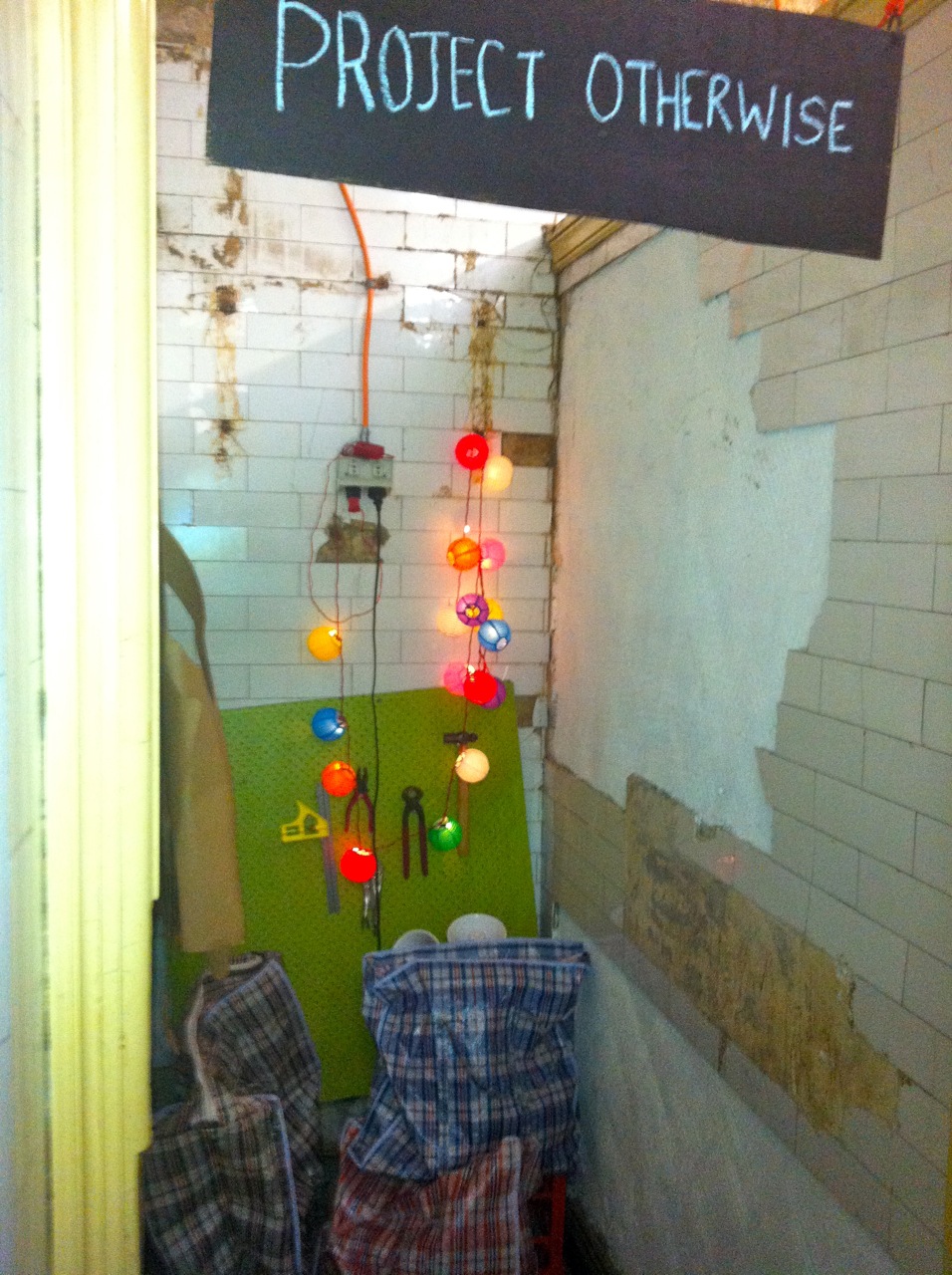
The first stall had some of those tartan laundry bags, colourful lights, tools and dressmakers' blocks to perhaps encourage people to start making their own clothes and building their own furniture. 


The "6 Jars" stall was an interesting concept. It's an idea that encourages people to think about what they eat, befriend their neighbours, and buy less packaged food. 
To put that into practice it asked people who live locally to sign up and they would be introduced to five like-minded locals who they could share food with. 
So you cook up "a batch of goodness" put it into six jars and share them with your new friends; they in turn do the same and you only need to cook dinner once a week. I quite like the idea.


I'm not certain what the Librarium stall was about, but assume it's to encourage people to share their libraries, which I often do anyway.  


At the end of the five stalls is another urinal area, which yesterday was home to typesetters' tools and an old fashioned printing press. 


The Makeshift art duo plan to print a little mini-mag or zine featuring sustainability ideas that arise out of a workshop that runs parallel with the installation in the neighbouring above-ground women's conveniences, which are housed inside the substation and were built in 1938, following much lobbying by women.
I wasn't allowed to sneak a peek in the women's because apparently its where stuff is stored for the Saturday markets and the market folk didn't want any old riff-raff snooping about in there.
But I was more than happy to have seen the men's conveniences, which closed in 1989, because of safety concerns.
The toilets are special because they are the last remaining of the ten men's underground toilets. 
The others were gradually demolished over the years, including as recently as 2003, when the City of Sydney council, under Lord Mayors Frank Sartor and Lucy Turnbull, demolished the lavatories at Hyde Park, Macquarie Place and Wynyard Park - despite protests by the National Trust and others.
Now that the Taylor Square men's conveniences have been heritage-listed, the question is, what to do with them?


*
SOURCES: