Showing posts sorted by relevance for query surrey street. Sort by date Show all posts

Friday, May 20, 2011

Darlinghurst Blog: History: 28-30 Surrey Street

A few weeks ago I received an email from a reader, who has been living in Darlinghurst on and off for the past 24 years, and was very curious about the history of ''Darlinghurst Place'', at 28-30 Surrey Street. 
The reader said she heard it was a garage in the 1970s, stables at the turn of the century, a bakery at some other point, and also once belonged to a man called Mr Hickey. 
I have walked past the place countless times when I used Surrey Street as a shortcut between Elizabeth Bay and Darlinghurst, and I had just assumed it was an old stable. 
But the reader aroused my curiosity and I set off at once to investigate, discovering along the way that the site has a very interesting history.


The titles for 28 and 30 Surrey Street are presently owned by Willpower Pty Ltd, a company directed by developer William Winterton, who has his offices on the left side of the building, fronting the street. Willpower purchased the two buildings in the 1980s and 1990s and I must assume - for I cannot be certain - that Winterton restored the site into apartment blocks - called The Mews, The Bakery and The Gatehouse (below) - and gave it the name, Darlinghurst Place. 
The right side of the street-facing building is leased by the Masuda Gallery, which according to its website specialises in ''Japanese vintage and contemporary textiles, works on paper and other decorative arts.'' The gallery is run by Masako Masuda and began exhibiting in June last year.


As for its history, the first mention I can find is back in February 1887, soon after the site was developed, when an advertisement was placed in the Sydney Morning Herald:

''New shop and dwelling to let, adjoining Messrs Hickey and Cahill's new Darlinghurst Bakery. First class locality. Apply Messrs Hickey and Cahill.''

In March and April of 1904 and November 1906, the buildings at 28 and 30 Surrey Street were again listed for lease in The Sydney Morning Herald:
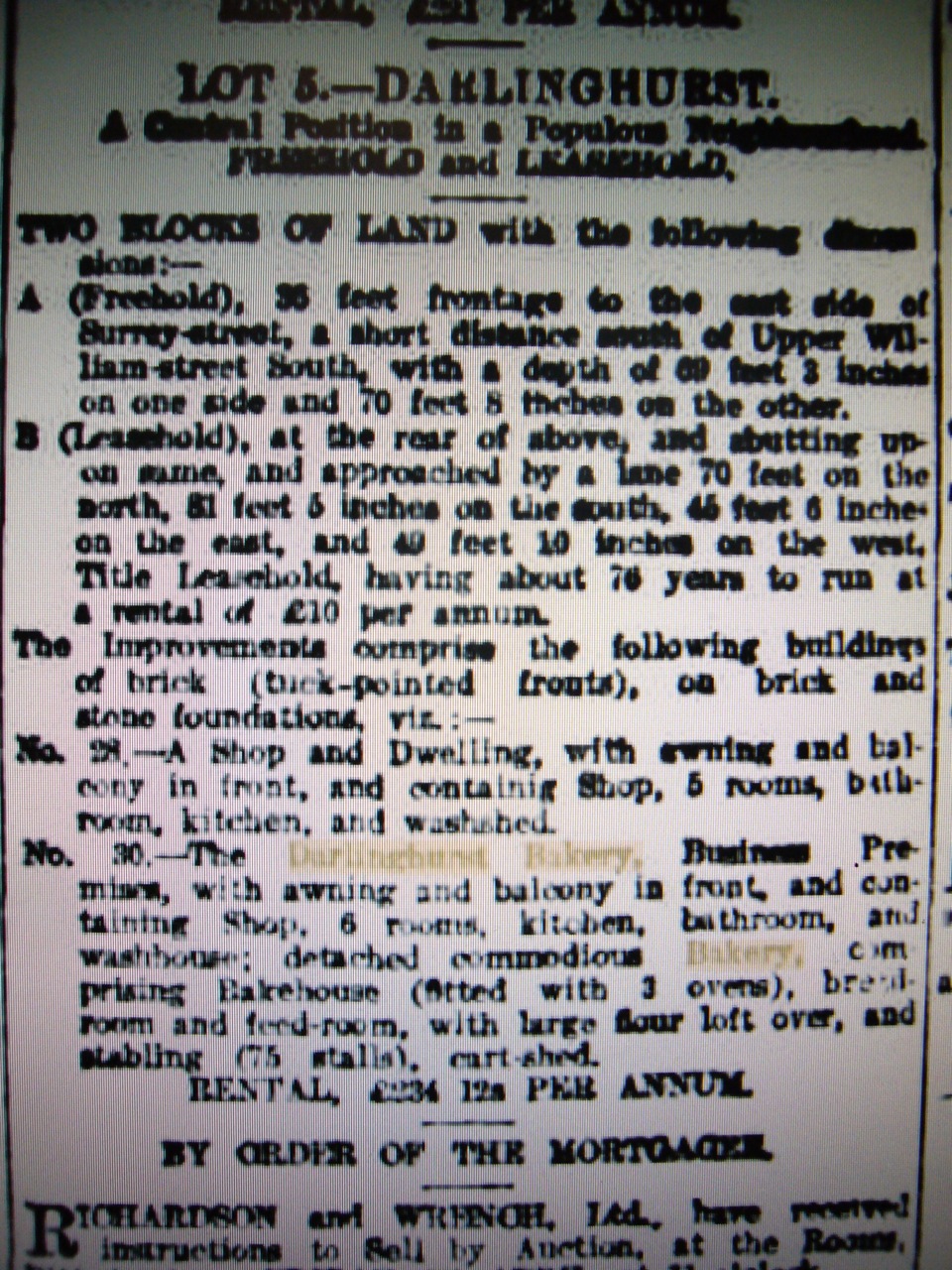

''No 28 - A Shop and Dwelling, with awning and balcony in front, and containing shop, five rooms, bathroom, kitchen and washershed.
No 30 - The Darlinghurst Bakery, Business Premises, with awning and balcony in front, and containing shop, six rooms, kitchen, bathroom and wash-house; detached commodious Bakery, comprising bakehouse (fitted with three ovens), bread-room and feed-room, with large flour loft over, and stabling (75 stalls), cart-shed.''

But it seems Mr Hickey stayed on at Surrey Street, for in September 1919, there was an obituary for a Mr O'Loughlin who ''died at the residence of his sister, Mrs David Hickey, Darlinghurst Bakery.''
There's not much to be found on David Hickey in the archives, except for another brief mention in  November 1906 when he and George Brown of Barcom Avenue nominated Phillip Henry Morton of Roslyn Avenue for the council elections in the seat of Bligh.
In August 1922, David Hickey also advertised for a ''strong lad for bakehouse, willing to learn trade, apply 9 O'Clock.''
And in May, 1925 a Miss Hickey of 30 Surrey Street offered a reward for ''four, one pound notes, lost between Darlinghurst and Waverley.'' 
How strange. I wonder if anyone ever handed in the money? 
Others who listed 28 and 30 Surrey Street as their address -  from 1910 to the late 1940s - include a Mr D Levy (at 30), Mr JD Fitzgerald (at 28, in 1910), John McDonnell (at 28, in 1921) and Mr LE Ball (1948). 
I suspect David Hickey died sometime in the 1940s, because in July, 1949, this advertisement appeared in The Sydney Morning Herald:


"Wanted to Rent or Buy, Cottage of Shack, close to water, reasonable distance Sydney. M Hickey, 30 Surrey Street, Kings Cross.''

And the following year, in July, this same M. Hickey placed another advertisement, which indicates he was packing up the bakery and moving to his new place by the water:

''For Sale: Elevator (dough) suitable for produce store or goods elevator, 100 Pounds.''


In the meantime, during the mid-1940s, a confectioner called Shevel Alexander moved into the building above. 
The Russian-born Shevel, also known as Sasha, inherited the confectionary business from his father, Leo Zapolsky (also known as Leo Alexander), who died in 1936. The family migrated to Australia from Manchuria in the 1920s.
In 1947, according to newspaper archives, the chocolate manufacturing operations were located at Oswald Lane. This little laneway runs from Womerah Avenue to Hickey Lane (named after the baker), but after looking at old maps, I believe the site of Alexander's Chocolates was actually at 28 Surrey Street. 
Here's a map from today and - correct me if I'm wrong - if you compare it to the next map, it looks like the chocolate factory was part of 28-30 Surrey Street:


Old map, showing Alexander's Chocolates on Hickey Lane:


In November 1947, Shevel advertised for ''Chocolate Packers. Girls, experience not necessary. Good wages and conditions. No Saturday work. Shevel Alexander Pty Ltd, on Oswald Lane, Darlinghurst.''
The Alexander family was big in the world of confectionary and Shevel also inherited the Peter Pan milk bar on Hunter Street, in the city, as well as a chocolate shop in George Street, next door to the Civic Theatre, also in the city. 
Life should have been sweet for Shevel, but in 1948 he suffered a setback:


Shevel's downfall made national headlines in July 1948 when a judge described the chocolatier's tax evasion as the worst ''to come before a court for many years''.
Tax investigators seized books and other documents during raids on his Bundarra Road, Bellevue Hill home, and his various businesses, which ''made it obvious that his account books were unreliable and did not disclose his true income.''
According to court reports, Shevel had understated his net income for the financial year 1944-45, by at least 1574 Pounds and for the following financial year, by 1075 Pounds. 
Shevel was fined 100 Pounds and ordered to pay 400 Pounds to the Taxation Department for each charge.
I don't know what happened to Shevel after that and here the trail of 28-30 Surrey Street ends.
Save for a brief mention in September 1952, when ''hundreds of Kings Cross housewives'' campaigned to have the disused bakery turned into a wholesale fruit market. 
The women presented a petition to the then Sydney City Council asking for the market to be established to prevent ''exploitation of the public by barrow men''.
''Kings Cross is the most exploited district in the metropolitan area,'' Alderman AW Thompson told The Sydney Morning Herald.
''Although there are some fine men among the barrow men, I have been told that some are men with criminal backgrounds.''


Fruit barrow men, corner of Springfield Avenue and Darlinghurst Road, Kings Cross, 1933.

Saturday, December 25, 2010

Darlinghurst: Detritus: Christmas Below the Coke Sign

Christmas Lights Above the Coke Sign, Christmas Eve, 2010.

It's a Friday night and Christmas Eve in Darlinghurst and the neighbourhood is empty. Residents have flown from the city, suburbia has decided to give the suburb of sin a miss for the night, and tourists are low key. 
Parking spots? 
Hundreds of them.
Yet over the past couple of weeks, people have been celebrating Christmas in Darlinghurst with trees, wreaths and colourful lights - in laundromats, dress shops and private homes. I wandered through the back streets seeking out such decorations and here is a collection of photographs taken on my jaunts.
I'll be back on Monday, December 27, with a reader's ripper of a story set in 1960s Darlinghurst, so make sure you check in next week.
Have a safe and happy Christmas dear readers! 


Stars and Lights, Burton Street Laundromat, Darlinghurst.

Christmas Tree, Caldwell Street, Darlinghurst.

Lights, Liverpool Street, Darlinghurst.

Bells, Surrey Street, Darlinghurst.

Red Christmas Tree, Forbes Street, Darlinghurst.

Christmas Tree, Hardie Street, Darlinghurst.

Kingsgate Shopping Centre, Kings Cross

Merry Christmas, Blossom Gardens Nursery, Burton Street, Darlinghurst.

Plastic Santa, Blue Spinach, Liverpool Street, Darlinghurst.

Christmas Tree, Womerah Avenue, Darlinghurst.

Red Door and Wreath, Womerah Avenue, Darlinghurst.

White Door and Wreath, Surrey Street, Darlinghurst.

Star and Wreath, Surrey Street, Darlinghurst.

Blue Lights, Surrey Street, Darlinghurst.

 Wreath, Craigend Street, Darlinghurst.

Nativity Scene, Nimrod Street, Darlinghurst.

Tinsel-Covered Bus, Oxford Street, Darlinghurst.

Christmas Tree, 22 Roslyn Gardens, Elizabeth Bay.

 Christmas Trees, 61 Roslyn Gardens, Elizabeth Bay.

 Miniature Christmas Tree, 46 Roslyn Gardens, Elizabeth Bay.

Lights on Frangipani Tree, 19 Roslyn Street, Elizabeth Bay

And my little tree branches!

Thursday, February 24, 2011

Darlinghurst: Houses: 40A Caldwell Street

I received a message last week from a Darlinghurst resident and reader who was concerned about the ''nasty development planned for the little lane with the beautiful historic sandstone wall that runs behind the terraces at the bottom of Beare's Stairs.'' 
I had seen the development application for 40A Caldwell Street, but had no idea where that address was and assumed it was a development planned for a site with an existing house. I knew nothing about a laneway or an historic sandstone wall, so set out to investigate.
Even if you walk along Surrey Street or use Beare's Stairs regularly, you may never have noticed a large wooden gate tucked away in the eastern corner of this Caldwell Street laneway. I certainly hadn't noticed it. But here it is:


Behind the wooden gate is a landscaped area that backs on to three Surrey Street terraces. It was difficult to see the landscaping, even when I looked over the gate, and under it:


This is the laneway, which was once a ''dunny lane'' that the reader mentioned and you can see the sandstone foundation wall on the right side of the right photograph. The area is about 2.6m wide and runs the length of three terraces at 79, 77 and 75 Surrey Street and has kind of been requisitioned by them to add an extra third of space to their back gardens. So the laneway is actually a private garden now and it is very difficult for anyone who doesn't live in these three terraces (below) to appreciate the sandstone foundation wall. 


The land - just 48m2 of it - is actually a separate Torrens title that dates back to the original 1800s subdivision of this area, now known as the Barcom Conservation Area. Perhaps because of its small size and obscure location, it was never developed. But now, the owners of 40 Caldwell Street (the blue terrace below right) have bought the title and want to develop the space. 


The terrace at 40 Caldwell Street is owned by a company called Specialist Advocates, whose sole directors are Federal Court judge Dennis Cowdroy and his wife, Jennifer. Specialist Advocates purchased the title for 40A Caldwell Street in November last year for a token $1 from grazier John Robison, who had inherited the title. 
There was a well-researched story in Tuesday's The Australian newspaper by Jodie Minus, which details the history of how the grazier came to have the title, which you can read here.
On February 2 architect Stafford Watts submitted a development application to the City of Sydney  council to build a $200,000 four-storey house with three bedrooms for the little site. The house will literally be wedged in to the site, right up against 40 Caldwell Street, which will act as a support wall:


If you look in the above illustration, you can also see how the front of the house will have a 4m high   ''sparrow-pecked'' sandstone ''plinth . . . to complement the sandstone base of No 40 Caldwell Street and provide a suitable backdrop to Beare's Stairs,'' according to the Statement of Environmental Effects submitted to the council. 
By law, there are also no windows on the side facing the backyards of 75, 77 and 79 Surrey Street, so their privacy isn't an issue. The only issue for those three terraces is sunlight and shadow, which is minutely detailed in the SOEE - but I won't bore you with that. And, of course, the loss of some of their garden.
I understand the reader's concerns about the disappearance of the historic sandstone foundation wall, but I frankly did not know about it anyway; it is only accessible and visible to the residents of those three Surrey Street terraces; and finally, there are loads of historic sandstone walls and foundations around Darlinghurst and I doubt the suburb will suffer for the loss of this one. 


Having said that, I really don't think the development application will be approved by the council because it is just seems far too daring and a little bit crazy to want to build a house on this tiny block. Access to the site for builders and scaffolding is also likely to be a major issue and just imagine if a bulldozer or grader or whatever accidentally bumped in to Beare's Stairs and damaged them. The spot would hardly get any sun and would just be a mosquito infested swamp. 
I also think it is a good idea to keep these heritage dunny-lanes as they are a rather peculiar relic of the past. What do you think? 


Interestingly, Mr Robison the grazier also inherited ''dunny lanes'' at 8A Nimrod Street (above left) and 24A Nimrod Street (above right, reclaimed by property owners years ago), which he has so far left unclaimed. 
The Griffin Theatre Company has applied to the NSW Land and Property Management Authority for possession of the title at 8A. The title apparently runs all the way along the backs of houses on Craigend and Caldwell streets, right past the theatre to the kerb. The theatre want the title so they can use the wide footpath area (below - apologies for the grainy night pic) for an alfresco day cafe and night bar. They will add another entrance to the theatre in the wall on the right.


To view the development application for 40A Caldwell Street, Darlinghurst, visit the council's site here.
The exhibition period closes on Thursday March 3. 
UPDATE: The exhibition period has been extended to March 25.

*
While on the topic of heritage, the submission period for the council's proposed redevelopment of Fitzroy Gardens was extended until February 25 - that's tomorrow! Be quick! 
Visit the Save Fitzroy Gardens website, which has an easy one-click-wonder-way to lodge your submission. 

Sunday, September 19, 2010

Darlinghurst Blog: History: Barcom Conservation Area


This history is taken entirely, with only small edits for style, from 
the NSW Government's Heritage Branch Website *
I have included it as a reference for myself and for readers of 
My Darling Darlinghurst who may be die-hard history buffs.
*If you believe I have infringed copyright, please contact me and I will happily remove this page.

Eora was the name given to the coastal Aborigines around Sydney. Central Sydney is therefore often referred to as Eora Country. Within the City of Sydney local government area, the traditional owners are the Cadigal and Wangal bands of the Eora. 
With the invasion of the Sydney region, the Cadigal and Wangal people were decimated but there are descendants still living in Sydney today. 

The Barcom Conservation Area incorporates much of a 71 acre parcel of land granted to Thomas West in two parts in 1812 and 1844. 
The area is defined by Craigend Street to the north, Barcom Avenue and Boundary Street to the east and south, and to the west, St Vincents Hospital and Victoria Street.

West, an Essex millwright, was transported to NSW in 1801 as a convict. Governor Macquarie granted West some 40 acres to the west of the creek that fed into Rushcutters Bay. The estate was known as Barcom Glen.

West erected Sydney’s first water-powered mill on his land in 1812. The mill was located off Boundary Street in Lindsay Lane (where the A is on the map above), downstream from a dam he built near Liverpool Street. He built a house and established an orchard by the mill just north of Liverpool Street.

Three generations lived at Barcom Homestead until the house was acquired by St Vincents Hospital in 1863. West also ran cattle on his property and operated a dairy - Macquarie donated a cow from the Government herds in appreciation of West’s milling operations, which continued into the 1890s.

In the 1820s, Governor Darling made 15 small grants at Darlinghurst and Potts Point to powerful civil servants to build homes. One of the earliest residences in the precinct, Craigend, was one of these homes.
Craigend was a fine house built by NSW Surveyor-General Sir Thomas Mitchell in 1828-31, and stood on about 4 hectares in the area bound by Victoria Street, Surrey Street and Kings Cross Road.

Land around Rushcutters Bay Creek was swampy and consequently West’s Estate was one of the last estates to be subdivided in close proximity to the city. The good water supply coupled with the undesirability of much of the area for residential development saw development of industry. Produce such as fruit, meat and butter were refrigerated in Barcom Street near the back of St Vincents Hospital on the premises of T.S. Mort, where ice was made, hence Ice Street.

The conservation area also incorporates part of the Riley Estate, the eastern boundary of which runs long the alignment of Little West Street. The Riley Estate was subdivided from the 1840s. The earliest residential subdivisions and development occurred in the vicinity of Craigend, along Surrey Street by the 1850s.
Improvements in William Street in the 1850s, coupled with the gold rushes, encouraged development in the area. St Vincents Hospital moved from Potts Point to Darlinghurst in 1870. Barcom Avenue was surveyed in the 1880s.

Early plans show the Barcom Glen divided into large allotments either side of Barcom Street. The Barcom Glen Estate was subdivided for auction sales from 1880-81.

The south-western section of the area was subdivided for sale in 1883, including allotments fronting Leichhardt Street (formerly Campbell Street). At this time a weatherboard building is indicated at Barcom Street.

Rushcutters Creek ran along the south-eastern edge of the area, later resumed for road purposes, and Boundary Street was formed.

The Darling Heights Estate, bounded by Victoria, Surrey and Caldwell Streets, was subdivided in the late 19th Century.
The area surrounding Lindsay Lane was subdivided with allotments south of Boundary Street in 1913 as the Barcom Homestead Estate.

Royston Street was a later overlay, subdivided from the Craigend Estate after the demolition of Craigend in 1921, and sold in 1923 and originally called Mitchell Court.

Monday, December 27, 2010

Darlinghurst: Reader Story: Stephen Hickmott and the Secret Tunnels

Marist Brothers College Class of 1965

A wonderful story of a boy's own adventure in 1960s Darlinghurst, by reader Stephen Hickmott (front row, last on the right), now aged 59 and living in Tasmania.

I was raised from a baby in a little house in Darlinghurst, on the opposite side of the Green Park Hotel, in Liverpool Street, just up from the corner. I went to Darlinghurst Public School through the years, up until 5th class, when I changed to the Marist Brothers College, on the corner of Liverpool and Darley streets. 

The former Marist Brother College, now the Alexandra Flats.

When I was about five we moved to the downstairs of a terrace house at 96 Surrey Street, which had a massive backyard. We stayed there from about 1955 to 1970, but my father remained there for another ten years.  My old man was a merchant seaman and later drove Green Cabs. 

96 Surrey Street.

The thing I would love to see again one day is a secret probably not many folks know about: the secret passageways that belonged to the old Darlinghurst Gaol. 
The passageways were beneath the Marist Brothers College and the manholes, or entrances to them, were boarded up after the brothers set a trap and caught me another fellow down there. 
You had to go down and along, crawling on your belly, into a small cell, only 3 feet high, which had shackles on its walls.
There was one entrance to the tunnels under the staircase in the school, which at the time was a broom closet, and there was another entryway in a room the brothers’ used briefly for music lessons. We found yet another entrance in the house where the brothers lived - when we accidentally emerged from the tunnel in to their residence. 


We first discovered the tunnels one day in 1968 when we got in to trouble and the brother told us to go and get the biggest cane in the school. As we were always getting into strife we looked ‘’everywhere’’, but of course never went into the other classes to get one.
While we happened to be looking around we opened the broom cupboard and there was a 20 feet long cane with a chimney sweep on it - we decided this was the one.
But as we were getting it out, we noticed a crack in the floorboards, so we lifted them up and discovered a tunnel down in to the dark . . . we put the floorboards back and decided to return later.
We opened the classroom door and started feeding the cane in. After about 15 feet went through, the class was laughing, but the brother jumped up and turned red and spat the dummy. He screamed ‘’Next door! Get a cane!’’. He didn’t see the funny side of it at all.
We got six each and detention for a month. 


About a week later we went back and started investigating the tunnels with a torch.
The tunnels were about 2 feet wide and made of lime and there were small rooms about 8 feet wide with shackles on the wall. I guess it was solitary confinement to the max.
We would mainly access the tunnel through one of the manholes that was in the art class, which was taught by a teacher and not a brother, meaning we could get away during the class by going down the floor under the desk.
We would usually turn our pants and shirts inside-out because we’d be white as soon as we came out, and then we’d turn them back around so it wasn’t noticeable.
This one time, we didn’t bother turning our uniforms inside-out because the old teacher had a 2-hour class and we thought we’d have plenty of time to clean up.
But someone – one of the teacher’s pets – went and told the headmaster we had gone underground, so he turned up with the other brothers to look for us.
We had made our way back to the art class by then and when we got near the entrance we heard the brothers calling to us to come out. They didn’t sound very happy about it either.
After a 15-minute stand-off they got a hammer and nails and threatened to nail us in, which they proceeded to do. 


Rear view of the old college.

We headed back to the broom cupboard exit to escape, but before we could get out the brothers realised they had been outsmarted so a general assembly in the yard was called.
We slipped out of the cupboard and joined in with all the other classes coming down the stairs from level one and two.
In the yard I was in the second row back, and the headmaster walked up each row. We stood out something shocking, covered in white. As the headmaster went past me, he said, ‘’Out!’’ and then he also got my mate up in the back row.
I received six cuts of the cane on each hand. And detention. Which was actually pretty bad because you had to stay until 4.30pm and that made the day really long. 
*
Ten years ago I moved down to Tasmania, where I grow cherry trees. I have many great memories of climbing all over the Cross on roofs and riding our billy-carts down Bayswater Road, and I would love to come back and explore the tunnels again.

*
NEXT WEEK: Violet Investigates the Secret Tunnels.